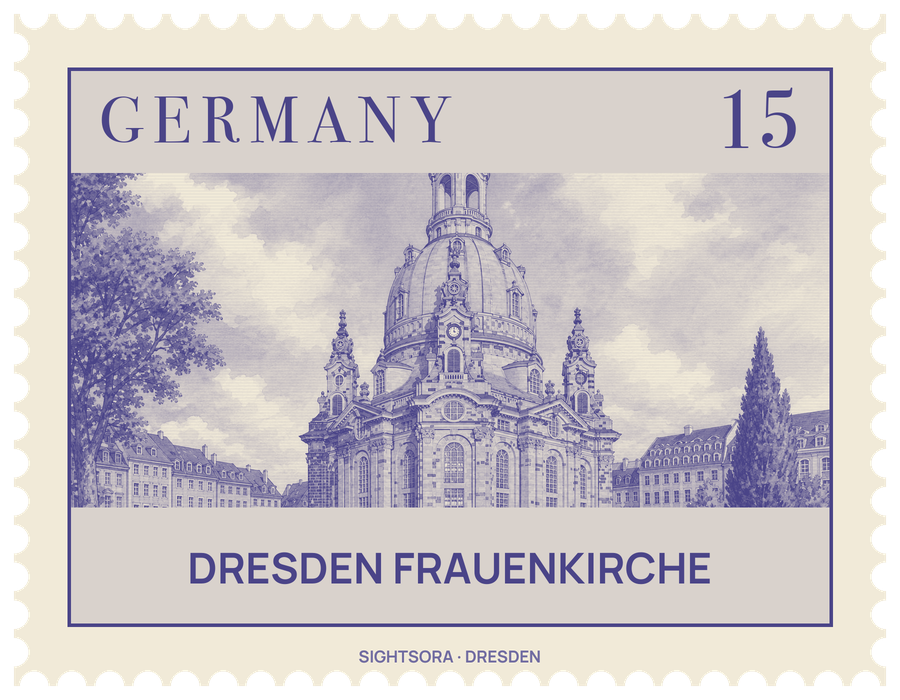
Destroyed in the Allied bombing of the city in February 1945, it lay in ruins for nearly half a century and was rebuilt between 1994 and 2005, largely from its original plans and with thousands of its own stones. It is a working parish church with services, prayers and concerts, and it has become a symbol of reconciliation between former enemies.
The building that stood here before the war was the third church on the site. Dresden's city architect George Bähr designed it, and it went up between 1726 and 1743, replacing a medieval church that had become Protestant at the Reformation. The citizens built it as a statement that the city would stay Protestant even though their ruler, Frederick August I, had become a Catholic in order to be King of Poland. Bähr placed the altar, pulpit and font in the centre where the whole congregation could see them, and crowned the church with a 67-metre dome of sandstone weighing 12,000 tons, carried on eight slender pillars and known as the Stone Bell. Johann Sebastian Bach played the church's new Silbermann organ in 1736, and in 1760, during the Seven Years' War, more than 100 Prussian cannonballs bounced off the dome. Bellotto painted its silhouette over the city, and so did Johan Christian Dahl in his View of Dresden by Moonlight.
When Dresden was bombed from 13 February 1945, the church held out for two days, long enough for 300 people sheltering in its crypt to get out. Then the heat of the fires, up to 1,000 °C, overcame the pillars, and on the morning of 15 February the dome fell in. Under East German rule the blackened heap stayed in the middle of the city, declared a "memorial against war" in 1966, and from 1982 it became a gathering place for silent protests with candles and flowers. After reunification a citizens' initiative led by the musician Ludwig Güttler, together with supporters in many countries, raised the money to rebuild.
Architects and engineers sorted the rubble stone by stone, measuring and cataloguing every usable piece and using computer models to work out where each had sat. Some 3,800 original stones went back into the walls, and their darker, fire-marked patina makes them easy to pick out among the new ones. The old altar, carved by Johann Christian Feige with Jesus praying at Gethsemane on the Mount of Olives, had survived in part, and two thousand of its fragments were cleaned and set back in place, and the carved oak doors were recreated from old wedding photographs sent in by the public. The gilded orb and cross on the dome were made in London by Alan Smith, whose father had flown in one of the bomber crews over Dresden; the charred old cross now stands to the right of the altar.
Inside, the painted interior has a soft glow that comes from pigments mixed, as in the 18th century, with large amounts of egg. The organ, by Daniel Kern of Strasbourg, was inaugurated in October 2005 and has 4,873 pipes and 68 stops, including all the stops of the Silbermann original. Beneath the main church lies the lower church, and the Frauenkirche also has a viewing platform with views across Dresden. A monthly Anglican Evensong is held in English. In front of the church stands a bronze statue of Martin Luther by Adolf von Donndorf, from 1885, which survived the bombing.