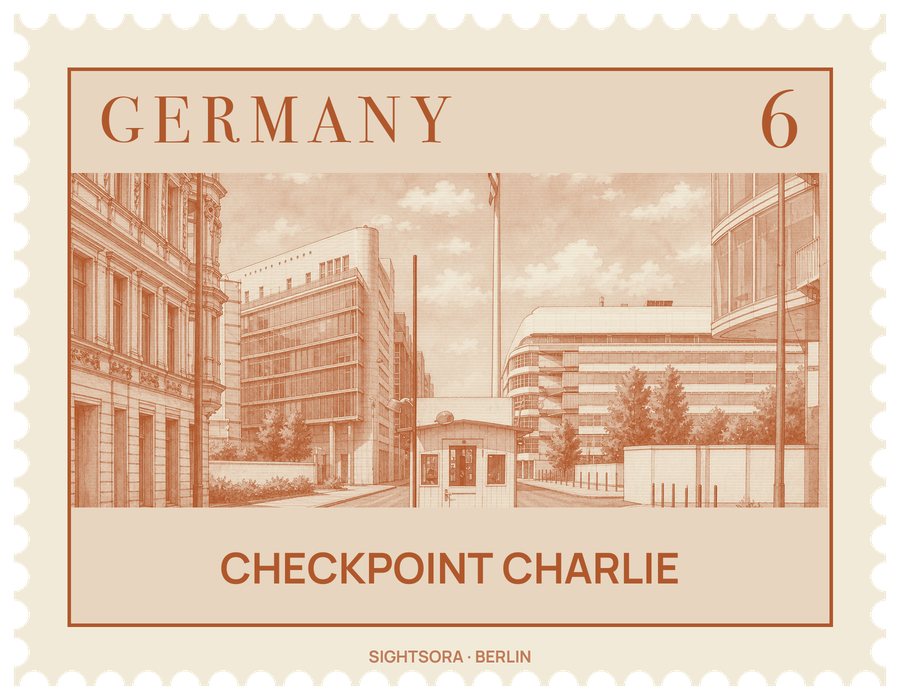
From 1961 until 1990 this was the crossing between East and West Berlin set aside for foreign tourists, diplomats and members of the Allied forces, and it became a symbol of the divided city during the Cold War. "Charlie" is just the NATO phonetic word for C, after the Allied checkpoints Alpha at Helmstedt and Bravo at Dreilinden.
The two sides built very differently. Over the crossing's 28 years East Germany added watchtowers, zig-zag barriers and a multi-lane shed for searching cars, while the Western Allies never put up a permanent building, because they did not regard the sector boundary as an international border. In October 1961, shortly after the Wall went up, a dispute over whether East German guards could check the papers of a US diplomat, Allan Lightner, led to ten Soviet and ten American tanks facing each other across the checkpoint; the stand-off ended peacefully on 28 October. On 26 June 1963 John F. Kennedy came here and looked over the Wall from a platform, and in August 1962 the teenager Peter Fechter bled to death nearby when border guards shot him during an escape attempt, with the press looking on.
After the border opened in November 1989, the booth was taken away on 22 June 1990. What visitors see today mixes original remnants with reconstruction: the guard house on the street is a copy resembling the first hut of 1961, while the last American guard house, a larger metal container from 1976, now stands in the Allied Museum, on the western side of the city. A line of cobblestones in the road traces where the wall and border ran. The East German watchtower, the last major original structure, was demolished in 2000, and the site was listed as a protected heritage area in 2018.
Gallery walls along Friedrichstraße and Zimmerstraße, put up as an open-air exhibition in 2006, explain escape attempts, the growth of the checkpoint and the tank confrontation, and point to other memorials and museums about the division. The BlackBox Cold War exhibition, open since 2012, adds original Wall segments outdoors and an indoor display with media stations, a cinema and original documents. Close to the guard house, the Mauermuseum – Museum Haus am Checkpoint Charlie opened on 14 June 1963, right beside the Wall; it shows photographs and fragments of the border and the devices people used to flee, including a hot-air balloon, escape cars and a mini-submarine.