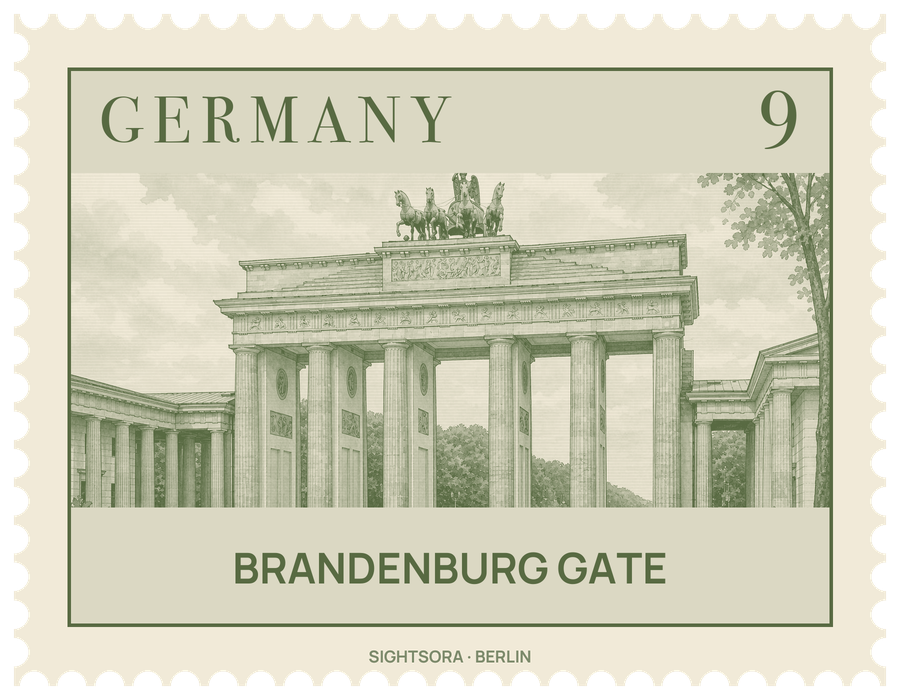
King Frederick William II of Prussia had it built between 1788 and 1791 to plans by Carl Gotthard Langhans, replacing a smaller gate that marked where the road towards Brandenburg an der Havel left the city. It is the last of Berlin's city gates still standing, and after decades as the emblem of a divided city it has come to stand for German reunification.
Langhans modelled the gate on the Propylaea, the entrance to the Acropolis of Athens, and it was among the earliest German buildings in the Greek Revival style. The columns form five passages; the central one, wider than the rest, was long reserved for the royal family. Reliefs of the Labours of Hercules decorate the walls between the columns, the metopes show scenes from Greek mythology, including centaurs fighting men, and lower wings at either side house open colonnades. With the quadriga on top the gate reaches about 26 metres, and it is 11 metres deep.
The quadriga, a chariot drawn by four horses designed by Johann Gottfried Schadow, was lifted onto the gate in 1793 and has always faced east, towards the city centre. Napoleon carried it off to Paris in 1806 after defeating Prussia, and when it came back in 1814 the goddess was recast as Victoria, holding a staff with the Prussian eagle and an Iron Cross. The gate came through the Second World War badly damaged; East and West Berlin, despite bitter arguments, cooperated on a repair that was finished in December 1957, recreating the quadriga from a plaster cast made in 1942. One horse's head from the original survives in the Märkisches Museum.
After the Berlin Wall went up in 1961, the gate stood in the restricted zone on the East Berlin side, with the Wall curving around it to the west, and viewing platforms in the West let people look over at it. Ronald Reagan stood here in 1987 to call on Mikhail Gorbachev to open the gate and tear down the wall. On 22 December 1989 the crossing reopened as Helmut Kohl walked through to meet Hans Modrow, and a crowd of a hundred thousand joined the occasion; a few days later Leonard Bernstein conducted Beethoven's Ninth Symphony here with "Freude" changed to "Freiheit".
Around the square stand the Adlon hotel, the Academy of Arts and the French and US embassies, and Haus Liebermann and Haus Sommer, which flank the gate as a matching pair. The Berlin Tourist Info sits in the gate's south wing, and the Reichstag, the Denkmal für die ermordeten Juden Europas and the boulevard of Unter den Linden are all close by. The gate and the avenue beyond also serve as the city's stage for large gatherings, from New Year's Eve fireworks to the finish of the Berlin Marathon.