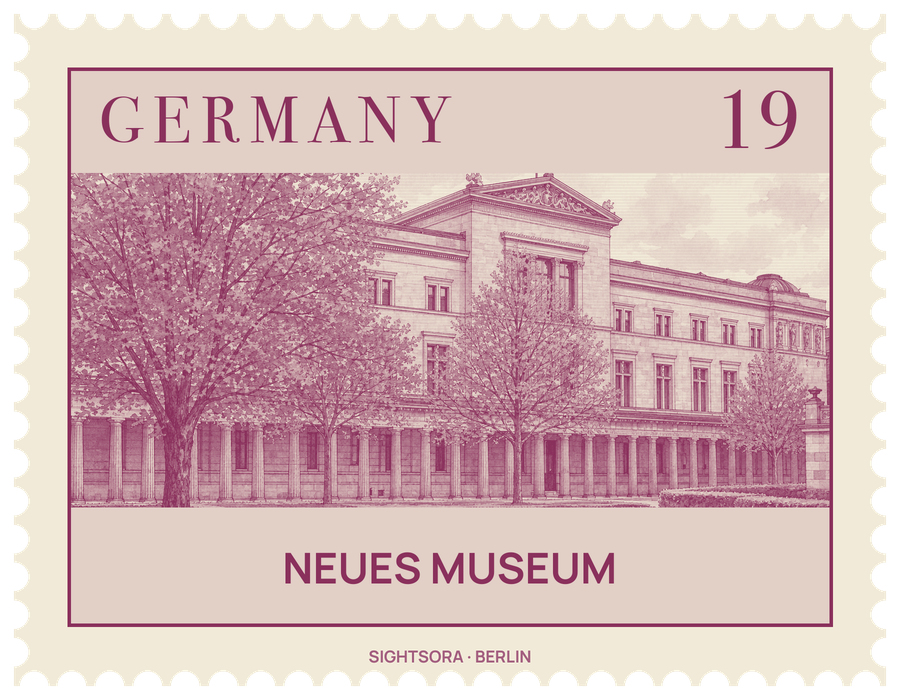
Its architect was Friedrich August Stüler, who had trained under Karl Friedrich Schinkel; he designed it, mixing Neoclassical and Renaissance Revival forms, and it was built between 1843 and 1855 on the orders of Frederick William IV, King of Prussia. Bombed in the Second World War and left to decay in East Germany, it was restored by the English architect David Chipperfield and reopened in October 2009. Since 1999 it has been a UNESCO World Heritage Site together with the rest of Museum Island.
It was the second museum on the island, put up to take the collections that no longer fitted into the neighbouring Altes Museum: plaster casts, Egyptian antiquities, prehistoric finds, ethnography and prints and drawings. The building site on the soft ground by the River Spree needed 2344 timber piles, between 6.9 and 18.2 metres long, rammed in with the help of a steam engine, and the structure made extensive use of iron, new techniques of the industrial age. Wall paintings in the main stairway were still being finished in 1866, eleven years after the museum opened.
The museum was closed in 1939. Bombs burned out the central stairway and its frescos on 23 November 1943, and in February 1945 the northwest wing and the bridge to the Altes Museum were destroyed. For decades the ruin was left to decay in the Soviet sector of Berlin, partly used as storage by the other museums. Chipperfield, appointed in 1997, rebuilt the northwest wing and south-east façade that the war had wiped out, keeping close to their original layout. His approach was disputed by those who wanted a more traditional reconstruction of Stüler's design, yet the finished building won a RIBA European Award in 2010, followed in 2011 by the European Union Prize for Contemporary Architecture.
Inside, Nefertiti is accompanied by other art from the time of King Akhenaten, the Egyptian collections having returned to the building where they began. The prehistoric collection lets visitors trace cultures through the Stone Age, Bronze Age and Iron Age, with treasures from the dawn of European history. The building itself is part of the display: its three main wings wrap around two inner courtyards, the Greek and the Egyptian, and the central stairway hall rises to 31 metres. Next door, the James Simon Galerie, also by Chipperfield, opened up an area near the museum that had been closed off, and the museum forms part of the archaeological promenade, an underground passage between the island's museums.