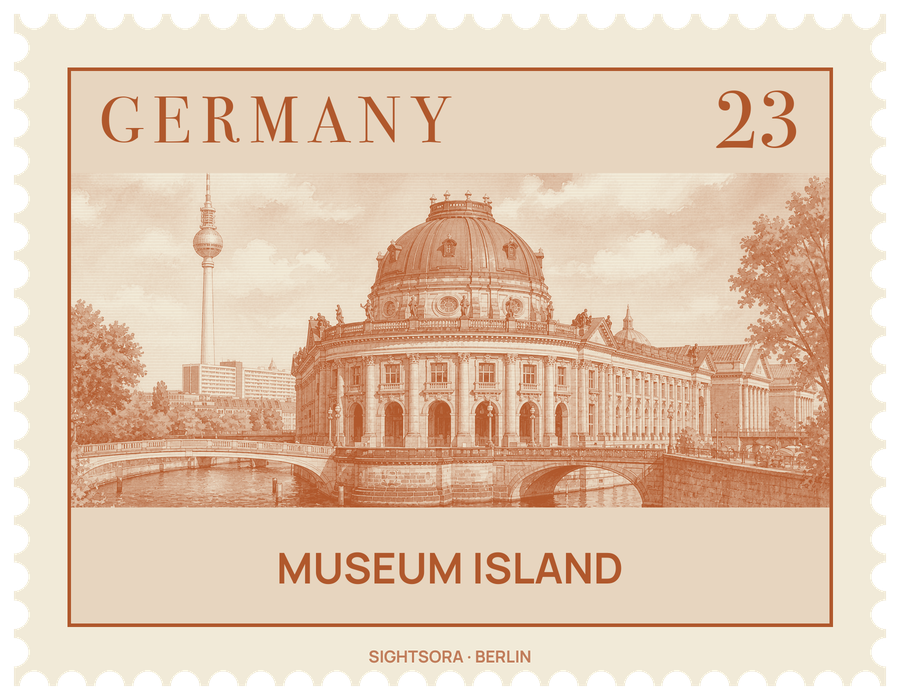
Five architects worked on them, first at the command of the Prussian kings, and in 1999 UNESCO listed the ensemble as a World Heritage Site for the way it records how the museum developed as a building type and a public institution over the 19th and 20th centuries. All five belong to the Berlin State Museums.
The story began in 1797, when the archaeologist Aloys Hirt suggested a first exhibition hall. Karl Friedrich Schinkel designed the Altes Museum in 1822 to show the royal collection of antiquities, with Wilhelm von Humboldt arranging the display, and it opened on 3 August 1830 as the Königliches Museum. In 1841 King Frederick William IV set aside the whole island, until then a place where people lived, for "art and science". Today the Altes Museum shows Greek and Roman art.
Behind it, the Neues Museum by Friedrich August Stüler, a pupil of Schinkel, was finished in 1859, wrecked in the Second World War and rebuilt under David Chipperfield, reopening in 2009 for the Egyptian Museum of Berlin; its archaeological collection includes the bust of Queen Nefertiti. Stüler also designed the Alte Nationalgalerie, completed in 1876 to hold 19th-century art given by the banker Joachim H. W. Wagener. On the northern tip, the Bode-Museum opened in 1904 under the name Kaiser-Friedrich-Museum and displays the sculpture collections alongside Byzantine and late Antique pieces. The fifth building, the Pergamon Museum, went up between 1910 and 1930, and the Stadtbahn railway viaduct crosses the island between it and the Bode-Museum.
The southern part of the island is not all museums. The Berlin Cathedral, a church rather than a museum, contains the crypt where the Hohenzollern dynasty buried its members and stands beside the Lustgarten park. South of the Karl Liebknecht Boulevard, the rebuilt Berlin Palace houses the Humboldt Forum, which opened in 2020, and just across the western arm of the Spree the German Historical Museum occupies the old Zeughaus on Unter den Linden.
After reunification the island was restored and extended under a master plan. The most visible addition is the James Simon Gallery by David Chipperfield, opened in 2019 next to the Neues Museum as the visitor centre for the whole site. It stands where Schinkel's Packhof service building was pulled down in 1938, and an underground passage lined with archaeological objects leads from it towards the neighbouring museums.