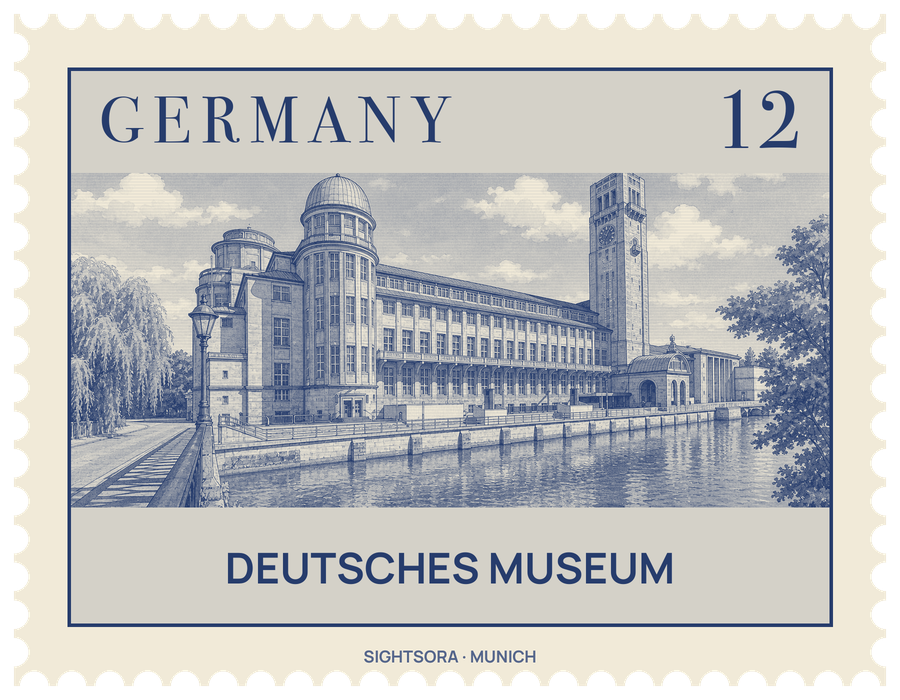
The island flooded so often that nothing was built on it before 1772, when the Isar barracks went up, and for centuries it was used for rafting timber; it was known as Kohleninsel, coal island, until the city gave it to the new museum in 1903 and it took its present name. Officially it is the museum of masterpieces of science and technology, which is how its full German title translates.
The engineer Oskar von Miller, who in 1882 had run a 57-kilometre high-voltage line into Munich from Miesbach, put the idea to the Association of German Engineers (VDI), whose meeting founded the museum on 28 June 1903. Its first collections were shown in the National Museum from 1906, and the building on the island finally opened almost ten years late, on 2 May 1925, which was von Miller's 70th birthday. Air raids had damaged 80 percent of the buildings by the end of 1944, and the regular exhibitions began reopening in 1948; in April 1945 the director Karl Bässler barely managed to stop retreating German troops from blowing up the last bridge to the island.
Its collections cover around fifty fields, from modern aviation and chemistry to health and musical instruments. Among the highlights the museum picks out are the first diesel engine, the microscopic theatre, a flight simulator, a huge cross-section of an Airbus fuselage and the nuclear fission table in the chemistry section, along with the antenna that in 1964 provided proof for the theory of the big bang. Every exhibition has interactive stations and push-button experiments, lifelike dioramas in glass cases make the subjects easy to grasp, and lab areas let visitors try experiments themselves.
Behind the galleries the museum keeps a research library of one million volumes and 53 000 articles, and an archive stretching across almost five kilometres of shelving, with company papers, technical drawings and manuscripts from nine centuries. From the start, von Miller paired the displays with a public library and archive open seven days a week, so that working people could use them.
The museum has other sites as well. The Verkehrszentrum at Theresienhöhe in Munich, opened in 2003, holds the road vehicles and trains moved from the island, from racing cars and steam locomotives to a penny-farthing and an ICE train, in three areas devoted to city transport, travel and mobility. The Flugwerft Schleißheim, some 18 kilometres north of the city centre near Schleißheim Palace, stands on the grounds of an early German military airbase founded just before the First World War and shows about 70 aircraft, from a Lilienthal glider to a Eurofighter, including a Horten flying wing glider from the 1940s and German vertical take-off planes of the 1950s and 1960s. Further branches are in Bonn and Nuremberg; the Nuremberg one, opened in September 2021, is devoted to the technology of the future.