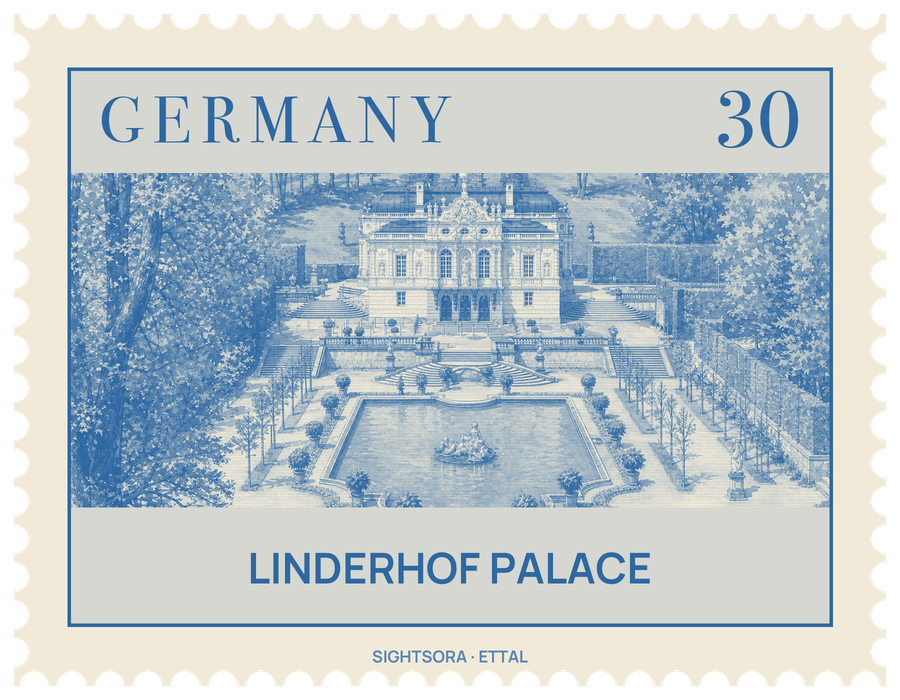
Linderhof was the only one of his palaces that was finished, and he lived here for much of the time from 1876 onward. The name has nothing to do with the old linden tree in the garden: it comes from the Linder family, who for centuries farmed the Hof, or farmstead, that stood on the site. Since 2025 Linderhof has been part of the UNESCO World Heritage Site of Ludwig's royal palaces, together with Neuschwanstein, Herrenchiemsee and the King's House on Schachen.
Ludwig inherited the lodge, the Königshäuschen, when he became king in 1864, began enlarging it in 1869 and in 1874 had it taken down and rebuilt elsewhere in the park, while new rooms and a staircase were added to the remaining wing and its wooden exterior was faced with stone. His model was Versailles and the absolute monarchy of Louis XIV, whose sun emblem appears throughout the rooms, though the style follows the Rococo of Louis XV and the scale is closer to the Petit Trianon. The staircase is a reduced version of the Ambassadors' Staircase at Versailles, and the bedroom, as in a French royal palace, is the largest room, but it faces north, in keeping with a king who slept by day and stayed awake at night.
The palace can only be seen on a guided tour. Among the rooms, the Hall of Mirrors, where Ludwig sat reading through the night, uses facing mirrors to create the illusion of an endless avenue, and the Audience Chamber served him as a study for planning new buildings rather than for receiving anyone. The dining room has a table that sank on a lifting platform to the kitchen below and came back up laid with the next course, so that the king could eat without servants in the room. The bedchamber, lit by a glass chandelier for 108 candles, was rebuilt from 1884 and was still unfinished when Ludwig died two years later.
The gardens, laid out by court garden director Carl von Effner, combine formal terraces with a landscape park of about 50 hectares that runs into the surrounding mountains. North of the palace a cascade of thirty marble steps climbs from the Neptune fountain to a music pavilion; to the south, terraces lead up to a small round temple sheltering a Venus statue. A linden said to be 300 years old was left standing in the formal garden despite spoiling its symmetry, and Ludwig liked to sit among its branches.
Scattered through the park are buildings that bring Wagner's operas and the East to life. The Venus Grotto, built between 1875 and 1877 under the stage designer August Dirigl, is an artificial cave of iron framing and cement stalactites that recreates the first act of Tannhäuser, with a lake, a shell-shaped boat and a painting by August von Heckel; in 1878 Johann Sigmund Schuckert installed 24 dynamos so that it could be lit in changing colours. Nearby stand Hunding's Hut from Die Walküre, rebuilt in 1990, and the Gurnemanz Hermitage from Parsifal, reconstructed in 1999/2000. The Moorish Kiosk was designed by Karl von Diebitsch for the Paris exhibition of 1867 and holds Ludwig's peacock throne, while the Moroccan House, made for the Vienna exhibition of 1873, was sold off after the king's death, bought back in 1980 and has stood in the park since 1998.
The park buildings are spread out on often steep paths, with gradients of up to 20 percent, and the Venus Grotto lies 50 m higher than the palace, so visitors should allow for some climbing between them.