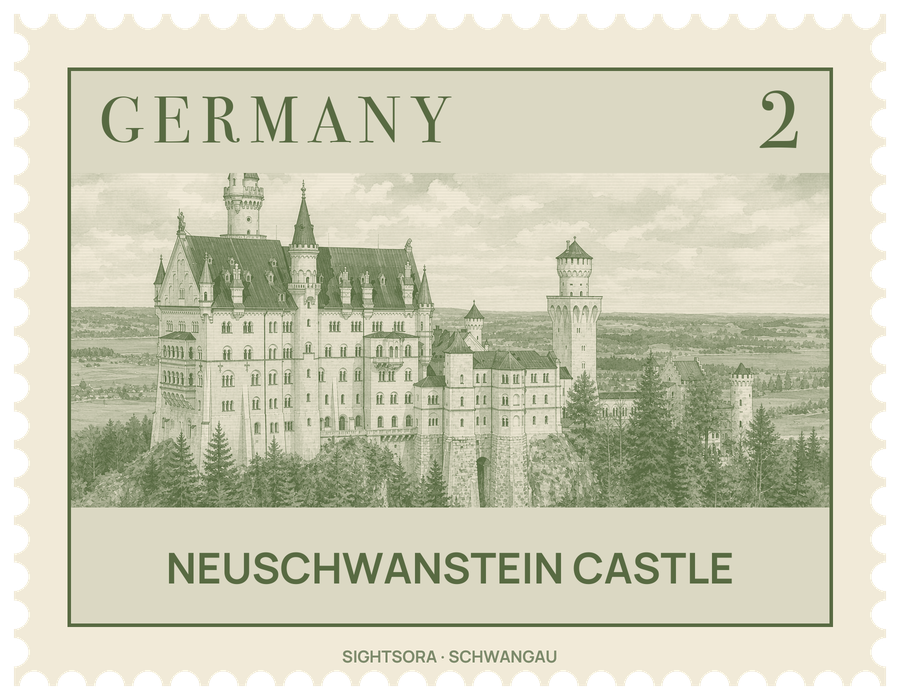
King Ludwig II of Bavaria had it built from 1869 as a private retreat and as a tribute to Richard Wagner, whose operas he revered, and it was never meant to house a court. In 2025 UNESCO inscribed it on the World Heritage List together with the king's other palaces: Neuschwanstein, Linderhof, the royal house on the Schachen and Herrenchiemsee.
Two ruined medieval castles stood here when Ludwig, who had spent much of his childhood at his father's Hohenschwangau Castle across the valley, decided to replace them. Visits in 1867 to the rebuilt Wartburg and to Pierrefonds in France fed his ideas, and the stage painter Christian Jank drew the design that the architect Eduard Riedel turned into plans; the king approved every draft himself. The foundation stone was laid on 5 September 1869, and he moved into the unfinished main building in 1884. The project was paid from the king's own funds and ever larger loans, and when his debts grew out of control the Bavarian government deposed him in June 1886; he was taken from the castle and died days later in Lake Starnberg. He had spent only 172 days here. Within six weeks of his death the castle was opened to paying visitors.
Seen from outside, the castle is a deliberately asymmetric chain of buildings about 150 metres long, with towers, turrets and gables meant to look like a Romantic knight's castle rather than a working fortress. Visitors pass through the red-brick Gatehouse into a two-level courtyard. In the upper court, the outline of a chapel and a 90-metre keep that were never built is marked in the paving, and the Rectangular Tower and the Bower frame a scene borrowed from the first act of Lohengrin. The main residential block, the Palas, has frescoes of the Patrona Bavariae and Saint George on its courtyard side and a two-storey balcony looking towards the Alpsee.
Only about 15 rooms were finished, and they are what the tour shows. The Throne Hall, 13 metres high, is ringed by arcades and modelled on the Allerheiligen-Hofkirche in the Munich Residenz; the apse meant for the throne stayed empty, and paintings of Jesus, the apostles and six canonised kings surround it beneath a chandelier shaped like a Byzantine crown. The Hall of the Singers, the largest room, combines two halls of the Wartburg and is painted with scenes from Lohengrin and Parzival. The king's apartments include a small artificial grotto inspired by Tannhäuser, a dining room linked to the kitchen three floors below by a lift, and a Neo-Gothic bedroom whose carved oak bed took fourteen carvers more than four years. The castle also had technology new for its time: telephone lines, a battery-powered bell system for servants, warm running water and flushing toilets.
The interior can be seen only on a guided tour. Above the gorge, the Marienbrücke is the steel bridge Ludwig had built in 1886 to replace the first wooden one.