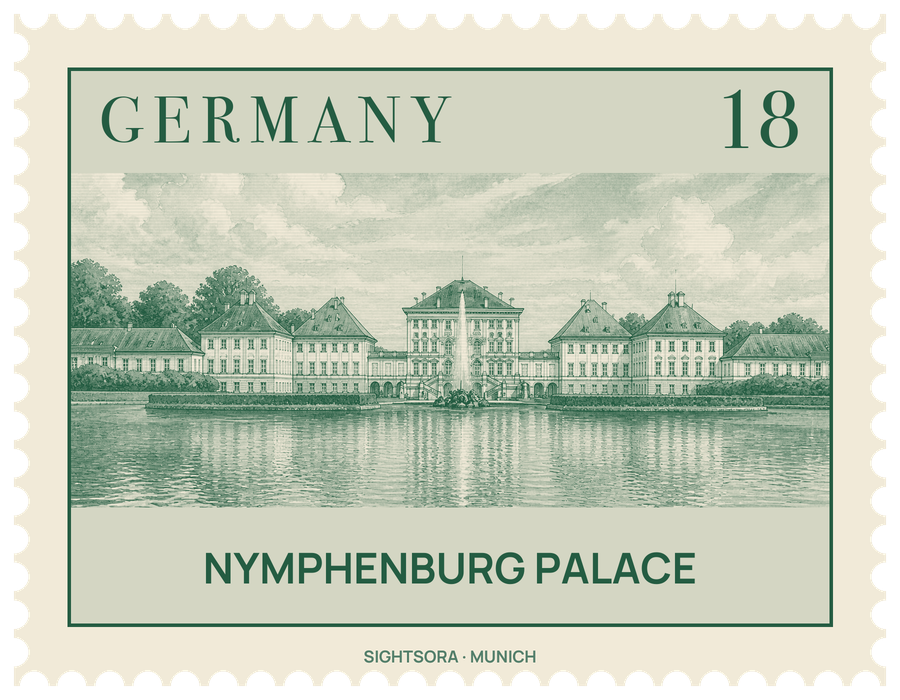
The elector Ferdinand Maria and Henriette Adelaide of Savoy ordered it in 1664, once their son Maximilian II Emanuel had been born, and its central block, built of Kelheim limestone to designs by Agostino Barelli and then Enrico Zuccalli, was finished in 1675. Max Emanuel enlarged it from 1701 with paired pavilions and gallery wings on either side, and later the stables, the orangery and a semicircle of small Baroque houses around the approach completed the long, symmetrical front that faces the city across a canal.
The palace stayed a favourite summer home of Bavaria's rulers: Emperor Charles VII died here in 1745, King Max I Joseph in 1825, and Ludwig II was born here on 25 August 1845, in a bedroom that can still be seen. The head of the House of Wittelsbach still has his home and office in the closed northern pavilion. At the heart of the royal apartments is the Steinerner Saal, the Stone Hall, which rises through three floors of the central pavilion under ceiling frescoes by Johann Baptist Zimmermann, with Helios in his chariot at the centre and decoration by François de Cuvilliés. On either side are rooms with their original Baroque ceilings, Brussels tapestries and portraits of the electors and their wives.
In the southern pavilion hangs the Gallery of Beauties that Ludwig I commissioned from his court painter Joseph Karl Stieler: 36 portraits of Munich women from every social class, among them the shoemaker's daughter Helene Sedlmayr and Lola Montez. In the south wing, the old court stables now hold the Marstallmuseum, a collection of state coaches and sleighs that includes the coronation coach of Charles VII from 1742 and the carriages and sleighs of Ludwig II. Upstairs, more than 1,000 pieces trace the Nymphenburg Porcelain Manufactory from its founding in 1747; the manufactory itself still works from one of the small houses on the palace forecourt.
Behind the palace, the park was laid out as an Italian garden in 1671, reshaped in French style by Dominique Girard and turned into an English landscape park by Friedrich Ludwig von Sckell in the first decades of the 19th century, who kept the formal Grand Parterre. A long canal runs west from the palace to the marble cascade of 1717, lined with statues of Greek and Roman gods, with lakes on both sides; the fountains still run on pumping stations from 1803–1808 that are driven by water. Scattered through the park are small palaces in their own right: the Pagodenburg, an octagonal tea house of 1716–1719 with Delft tiles below and chinoiserie above; the Badenburg bathing house; the Magdalenenklause, a sham ruin built in 1725–1728 as a hermitage for prayer; and the Amalienburg, a Rococo hunting lodge by Cuvilliés with a hall of mirrors and a room for the hunting dogs. A passage north of the Grand Parterre leads to Munich's Botanical Garden.
Besides the palace museum, the Marstallmuseum and the porcelain collection, the complex also houses the Museum of Man and Nature in the north wing, and there is a restaurant with a beer garden in the outer south wing.
Getting there
Tram 17 runs to Schloss Nymphenburg through the city centre, passing Stachus and the main train station.