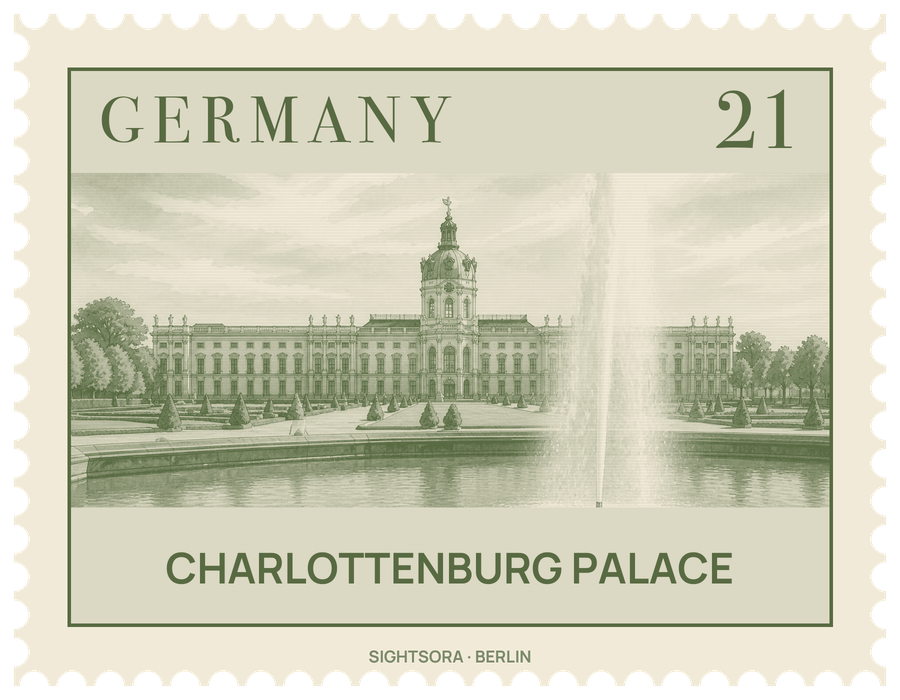
Its core, the Altes Schloss with its domed tower, dates from around 1700, and each generation rebuilt rooms and garden corners to its own taste. Walking through the palace today, visitors see how court fashion and royal living changed from the Baroque to the early 20th century.
Sophie Charlotte, whose husband Frederick III then ruled Brandenburg as elector, commissioned the first building in the village of Lietzow. Johann Arnold Nering designed it as a single Baroque wing, and it was inaugurated on 11 July 1699 under the name Lietzenburg. After Frederick crowned himself king in 1701, his architect Eosander von Göthe, fresh from studying Versailles, added side wings around a large courtyard, the Orangery and the tall central dome, topped by a gilded figure of Fortuna that turns with the wind. When Sophie Charlotte died in 1705, the king renamed the palace Charlottenburg in her memory.
The Baroque state rooms of the Altes Schloss are the highlight of a visit. The Porcelain Room, the palace chapel and the bedroom of Frederick I stand out, and the court painter Jan Anthonie Coxie covered the chapel and the porcelain room with frescoes between 1701 and 1713; in the porcelain room Aurora drives away Night to clear the path for Apollo, a flattering picture of the new king's rule. The famous Amber Room was first made for this palace, designed by Andreas Schlüter, before Frederick William I gave it to Tsar Peter the Great in 1716. An introduction to the Hohenzollern dynasty opens the tour.
Frederick the Great added the east wing from 1740 under Georg Wenzeslaus von Knobelsdorff, and Johann August Nahl designed its upper floor with the White Hall and the Golden Gallery. Frederick William III and Queen Louise later lived in this wing for much of their reign. Bombing in 1943 left the palace badly damaged, and after the ruined Stadtschloss in East Berlin was pulled down in 1951 many expected Charlottenburg to share that fate. Margarete Kühn, director of the State Palaces and Gardens, pushed for its reconstruction instead, and new ceiling paintings by Hann Trier were added to the restored rooms.
Behind the palace stretches a garden first laid out in 1697 by Simeon Godeau in a geometric style that followed André Le Nôtre, the gardener of Versailles, reshaped from 1787 as an English landscape park, and restored to Baroque form at its centre after the Second World War. Beyond the Carp Pond, the Belvedere by Carl Gotthard Langhans, built in 1788 as a teahouse and lookout, holds a collection of Berlin porcelain. The neoclassical mausoleum by Heinrich Gentz, built between 1810 and 1812 for Queen Louise, contains her reclining effigy in Carrara marble by Christian Daniel Rauch, along with the graves of Frederick William III, William I and Augusta. North of the palace, the New Pavilion, an Italianate villa by Karl Friedrich Schinkel from 1825, shows arts and crafts from Schinkel's time.
Getting there
The palace stands at Spandauer Damm 10-22; the public transport stop is called Berlin, Schloss Charlottenburg.