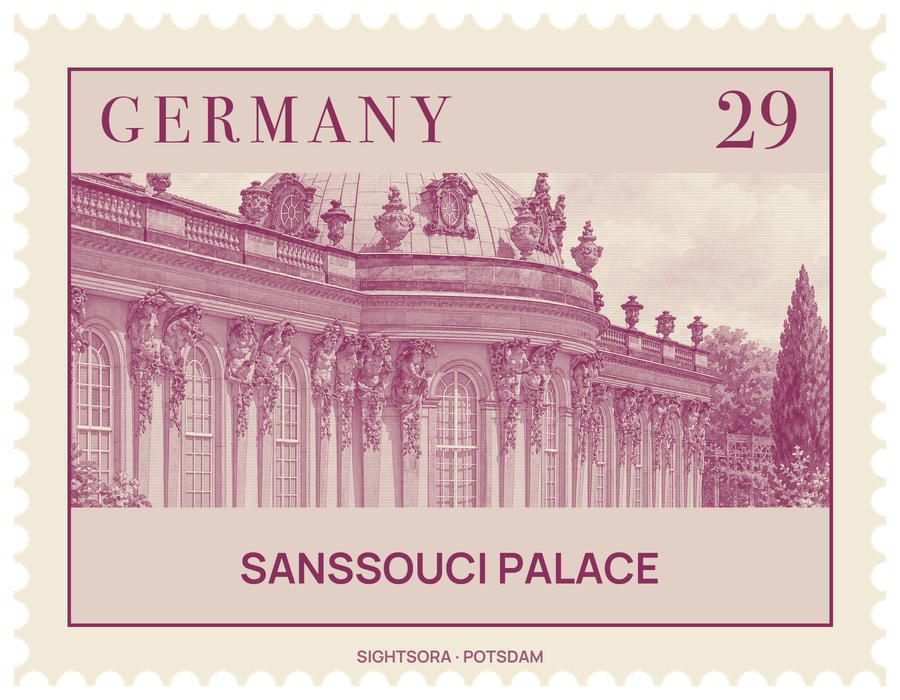
Its name is French for "without worries", and the king meant it literally: this was where he withdrew with his dogs, away from court ceremony, and where he asked to be buried. Georg Wenzeslaus von Knobelsdorff built it between 1745 and 1747 from the king's own sketches, and its 18th-century interiors survive in their original form. Together with its park, it has been a UNESCO World Heritage Site since 1990.
Frederick called it his "little vineyard house", and the hillside came first. On 10 August 1744 he ordered the bare southern slope to be cut into terraces, with vines trained against the retaining walls and figs growing in 168 glazed niches; a central flight of steps, now 132 in number, runs down through them to the garden below. The palace sits on the top terrace and has just ten principal rooms, entered at ground level straight from the garden as the king wanted. On the garden side, pairs of sandstone Bacchants carry the balustrade between the windows, and the dome bears the name in gilded bronze letters, oddly punctuated as "Sans, Souci.". The north side is the entrance front, where a semicircular courtyard is framed by colonnades of 88 Corinthian columns.
Inside, the oval Marble Hall under the dome was the main reception room, with paired columns of Carrara marble and figures of Venus Urania and Apollo by François Gaspard Adam. The king's rooms lie to the east. The music room is covered in Rococo ornament and keeps a fortepiano made by Gottfried Silbermann in 1746 that belonged to Frederick, and the round library, reached through a narrow passage from the bedroom, is panelled in cedarwood and once held some 2,100 books, many of them works of Voltaire. The study and bedroom were redone in plain classical style after his death in 1786, though in the 19th century his desk returned, together with the chair he died in. West of the Marble Hall are the guest rooms, among them the Voltaire Room, decorated with carved and painted parrots, apes, cranes, fruit and flowers on yellow panels.
The king's wish to lie on the top terrace was finally carried out in 1991, after German reunification, when his coffin was placed in the crypt he had prepared there, at night and without ceremony. His grave is on the upper terrace beside the palace. A century after Frederick's accession, in 1840, his great-grandnephew Frederick William IV took up residence in the guest rooms with his queen, and he enlarged the side wings between 1840 and 1842; the west wing, known as the Ladies' Wing, gave rooms to ladies-in-waiting and guests.
The palace is part of a larger ensemble. To the east, the Picture Gallery was built from 1755 to 1764 by Johann Gottfried Büring on the site of a greenhouse, and to the west the New Chambers of 1771 to 1775, a guest house, mirror its exterior. At the foot of the terraces, the Great Fountain stayed dry in Frederick's lifetime because the engineers could not make the hydraulics work; only from around 1842, with steam power, did it shoot water up to 38 metres, pumped from an engine house disguised as a mosque. A straight avenue 2.5 km long runs through Sanssouci Park from the obelisk of 1748 to the New Palace, the far grander building Frederick put up about twenty years later and himself called a "fanfaronnade".
Getting there
The palace is at Maulbeerallee in Potsdam, and the nearest public transport stop is Potsdam, Schloss Sanssouci.