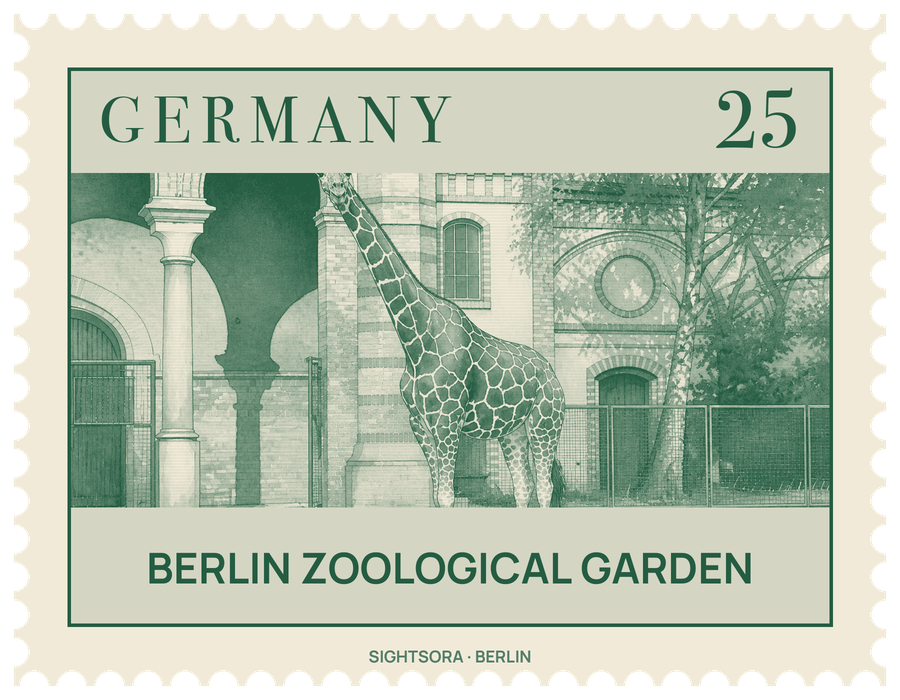
It opened on 1 August 1844, stocked with animals that King Frederick William IV gave from the royal menagerie on the Pfaueninsel and the pheasantry of the Tiergarten. The aquarium, added in 1913, houses fish and other water life as well as most reptiles, amphibians and invertebrates kept by the zoo.
There are two ways in. The Elephant Gate on Budapester Straße, next to the aquarium, is an exotic gateway first built in 1899; it was destroyed in the Second World War and rebuilt to the original plans in 1984. The Lion Gate opens onto Hardenbergplatz by the station. Inside, all four kinds of great ape live at the zoo: gorillas, orangutans, bonobos and chimpanzees. The carnivore house shows the big cats and rare small predators such as mongooses from Madagascar, with a basement given over to nocturnal animals, and the bird house has an aviary that visitors walk through. The aquarium is one of the few places where the tuatara can be seen.
Some animals have become part of Berlin's own story. Bao Bao and his mate Tjen Tjen, a gift from China to West Germany in 1980, were among the first giant pandas the country ever had, and giant pandas came back in 2017 when China lent the pair Jiao Quing and Meng Meng for breeding; Meng Meng had twins in 2019 and again in 2024. The polar bear Knut, born here on 5 December 2006 and raised by hand by his keeper Thomas Dörflein after his mother rejected him, drew crowds from far beyond the city until his death in 2011. The zoo also keeps studbooks for black and Indian rhinoceroses and takes part in European breeding programmes.
The zoo has a darker history too. Between 1878 and 1931 it staged 25 so-called Völkerschauen, shows in which indigenous people were put on display, among them Kawesqar people brought by force from Tierra del Fuego in 1881. In 1938 it removed Jewish members from its board and made Jewish shareholders sell their stock at a loss, and from 1939 Jews were barred from visiting. Bombing in 1943 and the fighting of April 1945 nearly wiped the zoo out: a count on 31 May 1945 found 91 of 3,715 animals still alive, among them the elephant Siam and the hippo Knautschke. The zoo was then rebuilt with enclosures meant to resemble the animals' natural surroundings, and since it lay in West Berlin, East Berlin built its own Tierpark.
Getting there
The zoo lies beside Berlin Zoologischer Garten station, known simply as Zoo, where U-Bahn, S-Bahn and bus lines meet. The Lion Gate is on Hardenbergplatz in front of the station, and the Elephant Gate is on Budapester Straße.