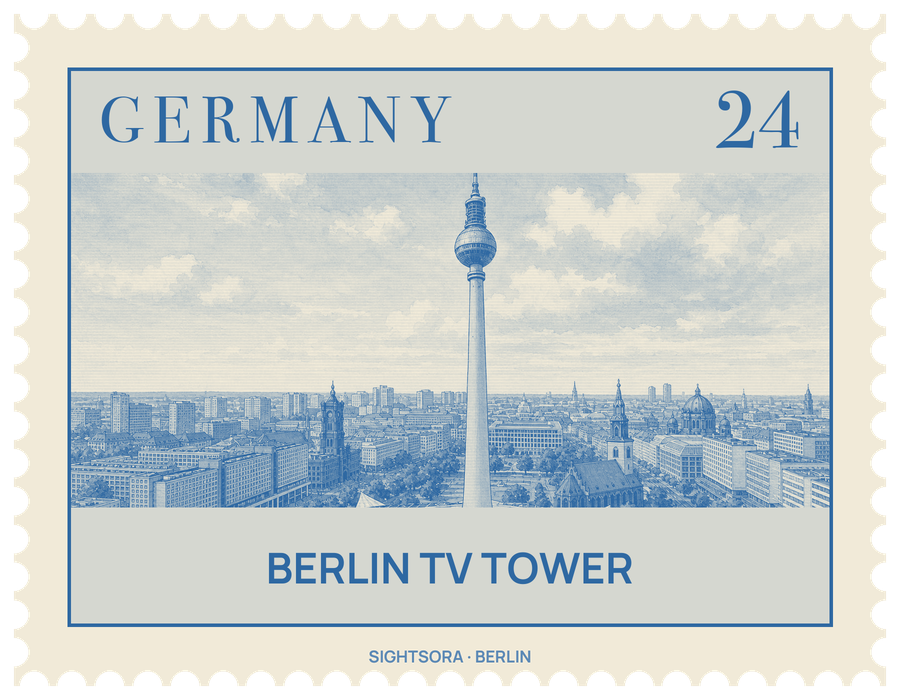
East Germany built it between 1965 and 1969 next to Alexanderplatz in the Mitte district, both to carry radio and television signals and to put a symbol of the socialist state on the skyline. Inside the sphere, about 203 metres up, an observation deck gives a 360-degree view over Berlin and the country around it.
The tower was a political project as much as a technical one. With only two frequency channels allotted to East Germany, a single powerful transmitter at a high point was needed, and in 1964 the leadership insisted that it stand in the centre of the capital. Walter Ulbricht approved a design that drew on the Fernsehturm Stuttgart and on the shape of the Sputnik satellite, and a team of architects including Hermann Henselmann worked on it. Clearing the site levelled a large part of the old city centre; the medieval St. Mary's Church still stands beside the tower.
Work on the foundations started on 4 August 1965, and the shaft reached its full height on 16 June 1967. The sphere, 32 metres across, was put together from 120 segments assembled first on a replica shaft on the ground and then lifted into place during 1968. Ulbricht inaugurated the tower on 3 October 1969, and the public has been going up since 7 October 1969. It became a protected monument in 1979, and after reunification, when some called for its demolition, it was kept and became an emblem of the whole city. A new antenna tip in 1997 raised it from 365 to 368 metres.
When sunlight falls on the sphere's stainless-steel cladding, the reflection usually forms a cross. Berliners called it the "Pope's Revenge", seeing it as heaven's answer to a government that had taken the crosses off the city's churches, and Ronald Reagan mentioned it in his speech of 12 June 1987.
Two lifts carry up to 12 people each to the observation deck in about 40 seconds, and the deck also has a bar. A few metres higher, at 207 metres, is Sphere, a restaurant whose floor revolves. On the ground, a virtual-reality film, Berlin's Odyssey, takes visitors through the building of the tower, nine centuries of Berlin history and parts of the tower closed to the public.
Getting there
The tower stands southwest of Alexanderplatz station, which is served by U-Bahn and S-Bahn lines and several tram and bus lines; the station's middle exit leads to the tower's entrance building.