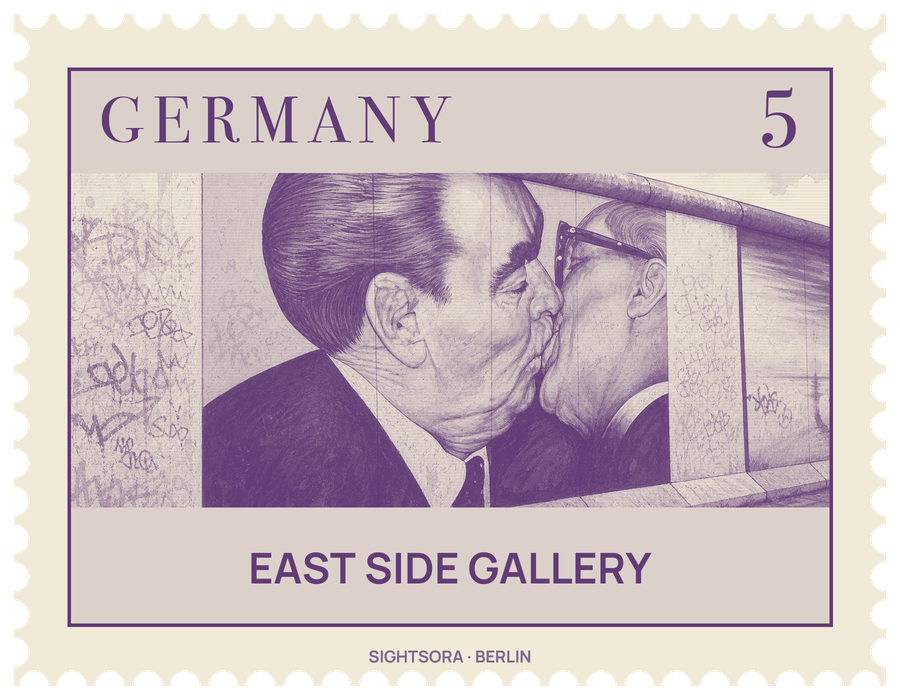
In the spring of 1990, months after the Wall opened, 118 artists from 21 countries painted more than a hundred works here, responding to the political upheaval of 1989 and 1990. The East Side Gallery is a protected heritage landmark, and the artists' association sees it as a memorial both to the Wall coming down and to borders between societies being settled peacefully.
The stretch is a reminder of how the border worked. Here the actual frontier followed the river's Kreuzberg bank, and the wall that survives here is the inner, "hinterland" wall that sealed the border strip off from East Berlin; the murals were painted on its eastern face, the side that once faced East Berlin. Unusually, local conditions meant this inner wall was built to look much like the outer barrier.
Walking the length of the gallery, visitors pass works such as Dmitri Vrubel's "Danke, Andrej Sacharow", Birgit Kinder's "Test the Rest", Gabriel Heimler's "Der Mauerspringer", Thierry Noir's paintings and Kani Alavi's "Es geschah im November". Weather, graffiti and vandalism took a heavy toll on the originals, and what is on show is the set of repainted versions made during the restoration that began in 2009, not the paintings of 1990. In 2006 a 40-metre section was shifted a short way west, parallel to its old line, to open a way from the Mercedes-Benz Arena to the river.
Since 1 November 2018 the Berlin Wall Foundation has looked after the monument and the park beside it. Its aim is to present both sides of the site: the art as an expression of joy at the peaceful end of German division, and the wall itself as evidence of the border regime of the German Democratic Republic.