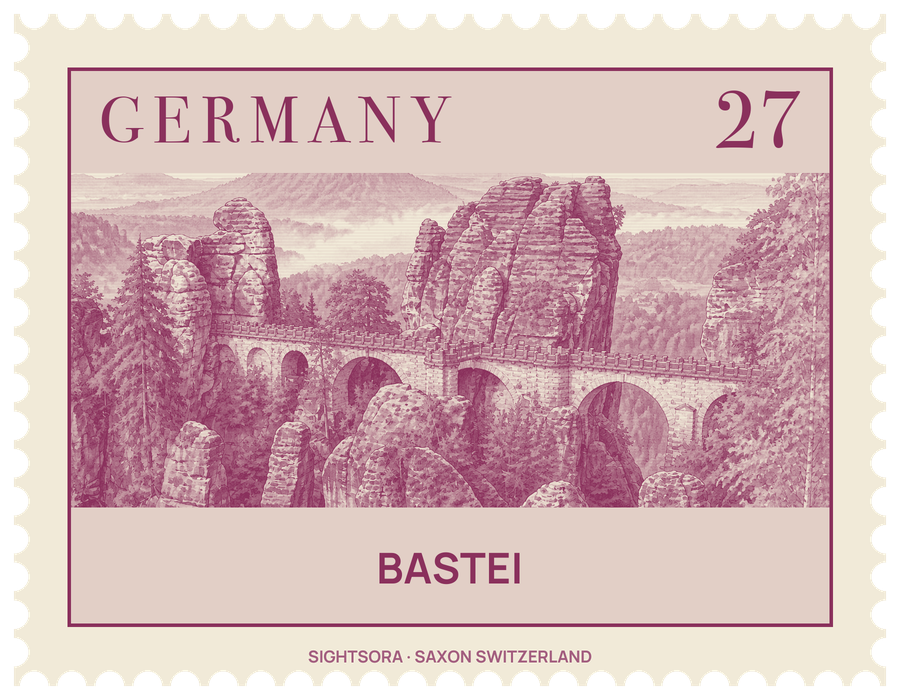
Water carved the rocks over more than a million years, and their tops reach 305 metres above sea level. They lie inside the Saxon Switzerland National Park, a climbing and hiking area that continues across the border into Bohemian Switzerland in the Czech Republic, and the long views over the river have drawn visitors for more than two centuries.
The name means "bastion": the steep rocks once formed part of the defensive ring of Neurathen Castle, and a state survey of the Electorate of Saxony recorded them as Pastey in 1592. Travel writers had discovered the spot by the end of the 18th century, and artists came on foot along the Malerweg, the Painter's Path, and the scenery inspired Caspar David Friedrich's painting Rocks in the Elbe Sandstone Mountains. A staircase of 487 steps up from the Wehlgrund valley made the climb from Rathen easier in 1814, a butcher from Lohmen started selling bread, beer and coffee from two huts in 1812, and an inn with rooms followed in 1826.
The centrepiece is the Bastei Bridge. A wooden bridge was the first to link the rocks over the deep clefts of the Mardertelle, and in 1851, as visitor numbers kept growing, it was replaced by the sandstone bridge that still stands: 76.5 metres long, with seven arches spanning a ravine 40 metres deep. On the Jahrhundertturm, a rock pinnacle by the bridge, tablets honour early tourism pioneers and the court photographer Hermann Krone, who photographed the scene here in 1853. A side path leads to the Ferdinandstein, from which the best-known view of the bridge opens up, and from the lookout the eye travels down to the Elbe and across to the rock massifs of Lilienstein and Königstein.
Crossing the bridge leads to the remains of Neurathen Castle, which visitors explore on a self-guided circular walk. Among the ruins are rooms cut out of the rock, a cistern, timber grooves in the stone and the stone balls once fired by medieval catapults; a replica slingshot has stood in the castle since 1986, and pottery found in excavations is shown as well. Conservationists pressed for protection of the area around 1900 and stopped a planned mountain railway, and in 1938 the rocks became a nature reserve, the earliest in these mountains. It now belongs to the core zone of the national park, where the strictest rules apply.
Getting there
Rathen, the spa village below the rocks, is the usual starting point, and paddle steamers on the Elbe link it with Dresden. The climb from Rathen passes an open-air museum on Slavic settlement in the region and the path to the Rathen Open Air Stage.