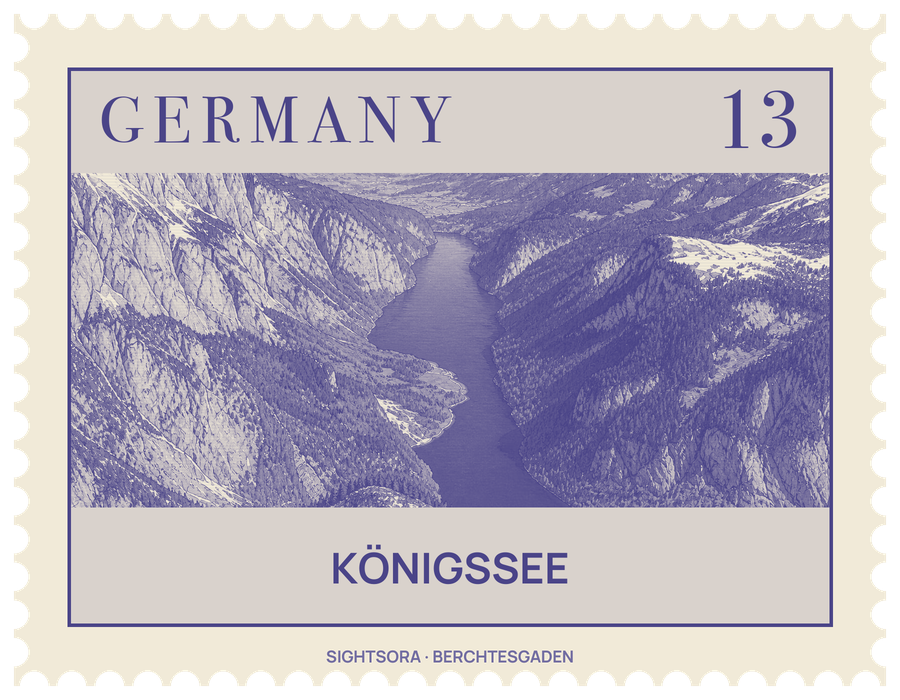
Glaciers carved it out of a Jurassic rift during the last ice age, and apart from its outlet at the village of Königssee, mountain walls rise steeply from the water on every side, some to 2,700 m, with the Watzmann massif to the west. The result looks much like a fjord, about 7.7 km from north to south and no more than 1.7 km across. Most of the lake belongs to the Berchtesgaden National Park.
Despite appearances, the name probably has little to do with a king: Bavaria had no kings between the time of Louis the German and 1806, and the lake was once called Kunigsee, most likely after local nobles named Kuno who appear in twelfth-century records. Its water is known for being clear, and since 1909 only electric passenger boats, rowing boats and pedal boats have been allowed on it. Swimming is permitted everywhere except the lock area at Seelände.
Because no path runs along the steep shore, the boats are the usual way down the lake. The Bayerische Seenschifffahrt company runs services from Seelände in Schönau to St. Bartholomä and Salet, with stops at Kessel on request; in good conditions the full trip to Salet takes two hours. On the way, the boat traditionally stops while someone on board plays a flugelhorn or trumpet against the rock walls, and the echo comes back up to seven times, as if a small band were answering. The only other ways to reach St. Bartholomä and the southern end are hiking trails over the surrounding mountains.
St. Bartholomä, a pilgrimage church with an inn beside it, occupies a peninsula on the west side, roughly midway along the lake. At the southern end, beyond the Salet moraine, lies the smaller Obersee, with the Röthbach waterfall dropping 470 m. In hard winters the Königssee can freeze, but walking on the ice is dangerous: in January 1964 a driver returning from St. Bartholomä went through it in his Volkswagen Beetle, and the car was not found until 1997, about 100 m down. The old Königssee Railway, which served the lake from 1909 to 1965, survives mainly as a walking path along its former route, and its Königsee station is now a restaurant.