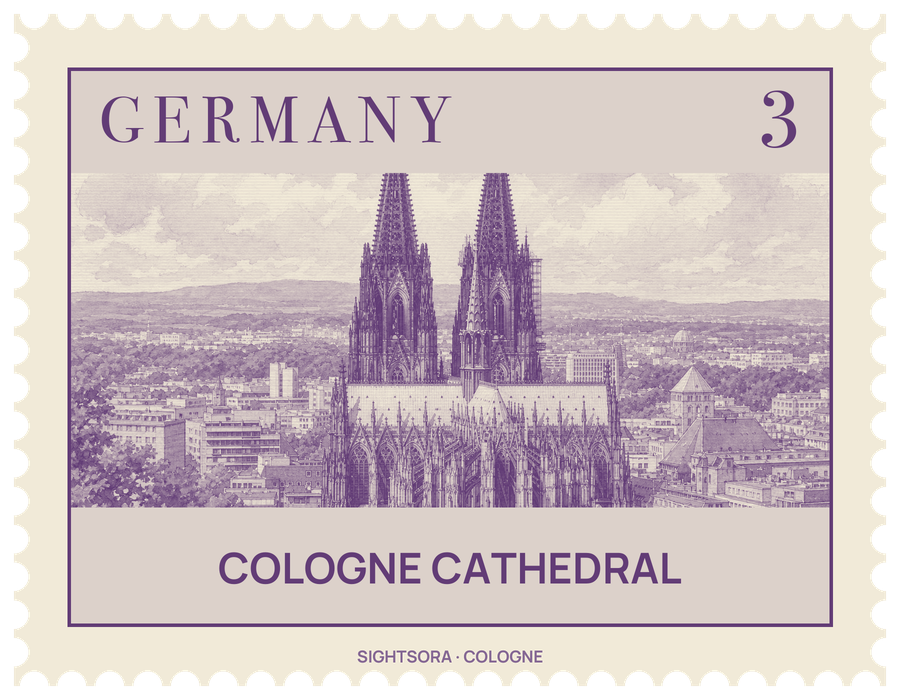
Its builders set out to make a fitting home for the relics of the Three Kings, brought from Milan in 1164, and the golden shrine that holds them is still the centre of the church. UNESCO inscribed it as a World Heritage Site in 1996.
Archbishop Konrad von Hochstaden laid the foundation stone on 15 August 1248, and the choir, laid out after Amiens Cathedral, was consecrated in 1322. Work stopped in the 16th century with the south tower only partly built and a great crane left on top of it, where it stayed as part of the city's skyline for 400 years. Romantic enthusiasm for the Middle Ages and the rediscovery of the original façade plan revived the project: building resumed in 1842 to the medieval drawings, paid for two-thirds by the Central-Dombauverein and one-third by the Prussian state, and the cathedral was declared complete on 15 October 1880, 632 years after it was begun. Hit by aerial bombs fourteen times in the Second World War, it stayed standing amid a flattened city and reopened in 1956. Maintenance never ends, and the Dombauhütte, its own workshop of stonemasons, keeps parts of it under scaffolding.
Inside, the plan is a Latin cross with two aisles on each side of the nave, and slender shafts run unbroken from the floor up to a very tall Gothic vault. The medieval choir keeps much of its original furnishing, including carved stalls, and a large stone statue of St Christopher by Tilman van der Burch watches over the spot where the old entrance stood. On the south side of the nave, Ludwig I of Bavaria donated a set of five 19th-century windows, the Bayernfenster, painted in the German style of his day, and the south transept holds Gerhard Richter's window of 2007, made of 11,500 equal squares of coloured glass arranged at random by computer.
The Shrine of the Three Kings, begun in 1190 by Nicholas of Verdun, is a gilded reliquary of bronze and silver shaped like a small basilica and covered with figures, enamel and gemstones. Near the sacristy hangs the Gero Crucifix, a large carved oak crucifix that Archbishop Gero is believed to have ordered around 960. Other works to look for are the Milan Madonna, a Gothic carving from about 1290 in the Sacrament Chapel, the high altar of black marble installed in 1322, and Stefan Lochner's altarpiece of the patron saints of Cologne in St Mary's Chapel. Further pieces are kept in the Cathedral Treasury.
The cathedral has eleven bells, four of them medieval. The largest, the 24-tonne St. Petersglocke, cast in 1922 and known in Kölsch as Decke Pitter, rings only on a handful of major feasts. Visitors can climb a stone spiral staircase of 533 steps to a viewing platform about 100 metres up, with a view over the Rhine.