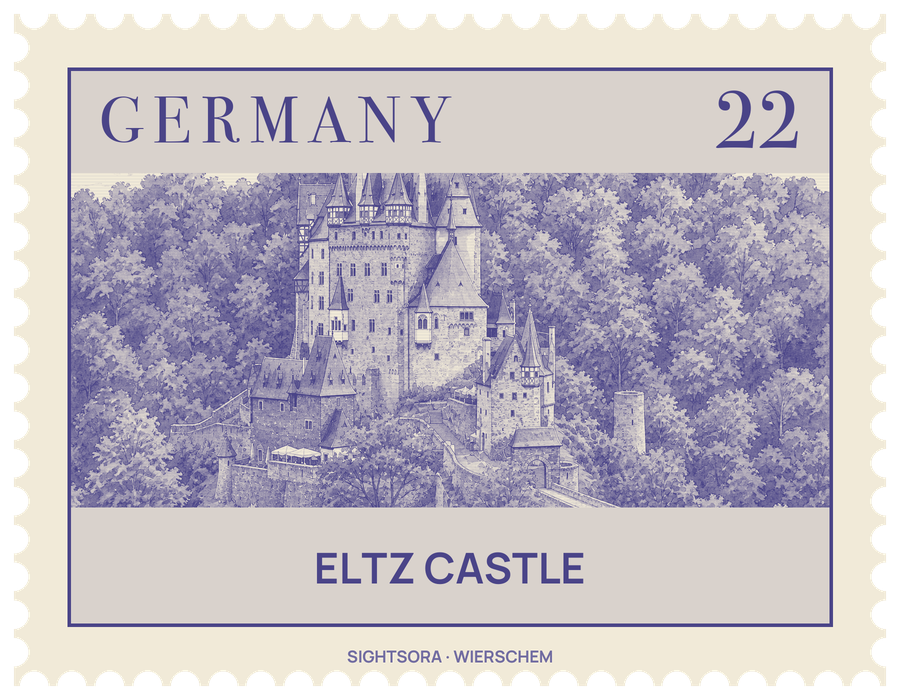
It stands near Münstermaifeld in the north of Rhineland-Palatinate, and the Eltz family has lived here since the 12th century, which the family counts as 900 years in the same house. The castle was never destroyed, so what visitors see is the medieval building itself rather than a later reconstruction.
Eltz is a Ganerbenburg, a castle shared by joint heirs. When the family split into three branches, each built its own block of living quarters while all three shared the walls and defences. The result is a cluster of eight towers between 30 and 40 metres tall, some rising to eight storeys, holding more than 100 rooms; at one time about 100 members of the families lived in them, with servants and craftsmen housed in a village below the south side.
The oldest part is the Platteltz, a Romanesque keep raised on the site of an earlier manor hall. The Greater Rodendorf House was begun by Philipp zu Eltz in 1470 and completed around 1520; its flag hall under a late Gothic vault was probably a chapel at first. The Rübenach branch finished its late Gothic wing in 1472, with a lower hall, a living room and a bedchamber with richly painted walls, and in 1615 the Kempenich house replaced the original hall with rooms that could all be heated.
Its only serious fighting came in the Eltz Feud of 1331–1336, when Archbishop Balduin of Trier besieged the castle from a small siege castle on the slope above; a few ruined walls of this Trutzeltz still stand on the north side. During the Palatinate War of Succession, when many Rhineland castles were destroyed, Hans Anton zu Eltz-Üttingen, a senior officer in the French army of Louis XIV, had his family's castle taken off the list of targets. Count Karl zu Eltz restored the building carefully between 1845 and 1888.
The Rübenach and Rodendorf wings are open to visitors, while the Kempenich branch of the family still uses its third of the castle. Beyond the rooms, the treasury holds pieces of gold, silver and porcelain, and the armoury shows historic weapons and suits of armour. Many visitors also know the castle from the engraving on the German 500 Deutsche Mark note, used from 1965 to 1992; one of the footpaths up from the car park passes a viewpoint named after that banknote. The outer bailey has a self-service restaurant with views over the castle and the valley, and the forest around it is a nature reserve crossed by several walking trails.
Getting there
Drivers should enter "Burg Eltz, Wierschem" into the satnav, which leads to the castle car parks. From there a shuttle bus runs to the castle, or visitors can walk, either along the road past a viewing platform or on a footpath past the "500-DM banknote" viewpoint.
Without a car, take the train to Hatzenport and then bus 365 to Eltz Castle car park 1; the bus runs only in the visiting season. Walkers can come from Moselkern via the Ringelsteiner Mühle, about two and a half kilometres away, or from Karden, about 6 km away, and the Moselsteig and the "Eltzer Burgpanorama" trail also pass the castle.