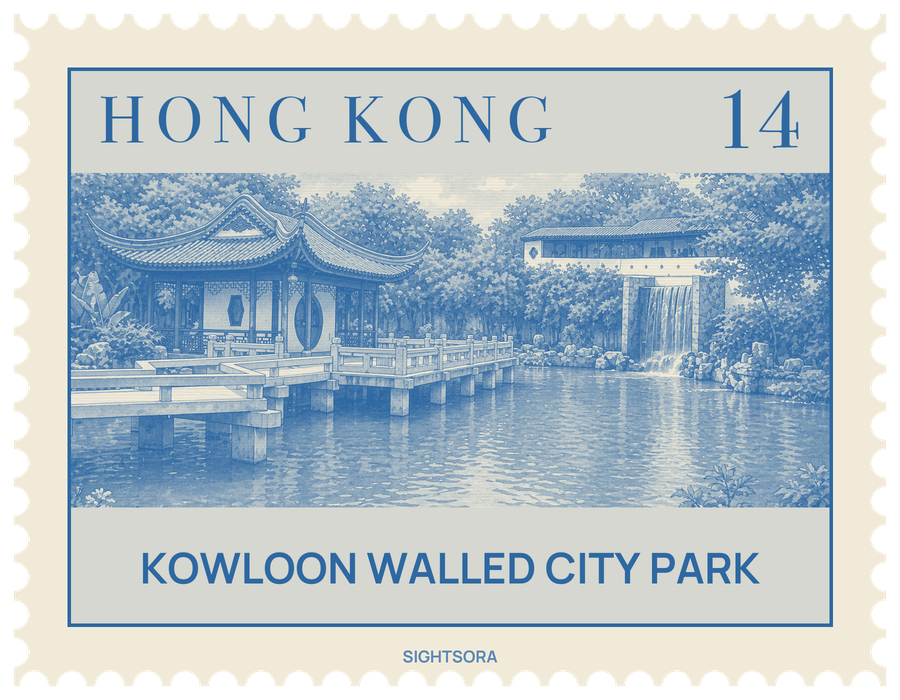
Divided into eight themed zones, each with its own scenery, it replaced what had been a slum, and a few surviving buildings and remains were kept and worked into the design. Its design was awarded a Diploma at the 1993 garden exposition in Stuttgart, IGO Stuttgart Expo 93.
The Qing government began building a walled enclave beside Kowloon Bay in the middle of the 19th century, first as a military post housing soldiers and their families. The Imperial Japanese Army pulled down the stone walls during World War II, though parts survived buried under the soil. Afterwards the enclave grew into a crowded city of its own, with some 41,000 people by the 1970s and 503 buildings by 1994; drugs, illegal gambling, prostitution and unlicensed medicine flourished, alongside small factories making textiles, sweets and jook-sing noodles. After the Sino-British Joint Declaration of 1984, Britain and China agreed to clear it: residents were resettled from 1987 to 1989, demolition began in 1993, and by 1995 the park had opened. Building heights around it were kept low, partly because of the nearby Kai Tak Airport.
At the centre of the park stands the Yamen, built in 1847 and the only old Qing building left. Inside were the offices of the Kowloon assistant military inspectorate and the commodore commanding the Dapeng Brigade, arranged in three rows and four wings with brick and granite walls under a tiled roof; after 1899 it served charitable purposes such as housing the elderly, and it is now a declared monument. Its six rooms hold a permanent exhibition, opened in April 2009, that uses images and sound to recreate living conditions inside the Walled City.
The site of the Old South Gate is also a declared monument. Excavation uncovered flagstone paving, the cornerstones of buildings and a drain, and in 1994 two granite plaques inscribed "South Gate" and "Kowloon Walled City" were found where the gate had stood. Nearby, an outdoor display shows a bronze miniature of the Walled City in front of a wall carved with a cross-section of the old city and scenes of its residents' daily lives.
Elsewhere in the gardens, 12 sculptures of the Chinese zodiac follow the order of the Earthly Branches and Heavenly Stems of Chinese astrology, and four large chessboards are set into the ground in pebbles for visitors to play on. The Guibi Rock, carved from Taihu stone and named for veins that resemble ancient jade, was meant to symbolise the hope of Hong Kong's return to China. From the Mountain View Pavilion visitors can look out to Lion Rock, which resembles a seated lion facing the pavilion, and the Kwong Yam Square west of the Yamen is planted with flowers for all four seasons.