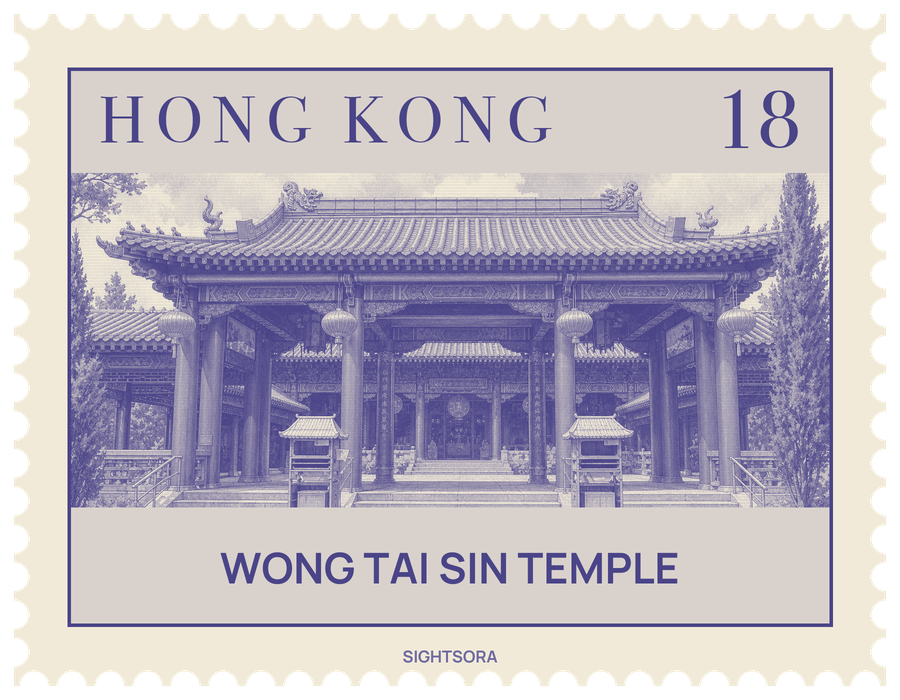
It is dedicated to Wong Tai Sin, the Great Immortal Wong, and it owes its fame to a belief that prayers made here are answered, summed up in the saying "What you request is what you get".
The cult reached Hong Kong with Leung Yan-am, who came from Namgong village in Guangdong Province in 1915 bringing a picture of Wong Tai Sin. He kept an altar first in his Wan Chai flat and then behind a herbal medicine shop, where customers prayed for help with their illnesses before he made up their prescriptions. After a fire destroyed the shop in 1918, Leung said that in 1921 the immortal had told him, through the Fu Ji method of spirit writing in sand or incense ash, to build a new shrine. The chosen spot lay in Chuk Yuen Village, about 3600 paces from Kowloon City Pier, and the shrine was largely paid for by four wealthy businessmen.
For decades this was a private shrine for Taoists and their families. Its following grew sharply among the refugees from mainland China who settled in the squatter districts around it during and after World War Two, and in 1956 it was finally opened fully to the public. It is run by Sik Sik Yuen, a Taoist organisation, holds the status of a Grade I historic building, and has government permission to hold Taoist weddings and issue marriage certificates.
Three memorial archways mark the route through the grounds; the first, at the entrance, carries the temple's name, and the second stands beyond the rows of fortune-telling stalls. Among the buildings are the Great Hall, a Nine-Dragon Wall copied from one in Beijing, and the Three-Saint Hall, whose altar honours Lord Guan, Guan Yin and Lü Dongbin. A portrait of Confucius hangs in the temple, which also keeps a library of Confucian, Buddhist and Taoist texts.
Most worshippers come for kau chim. After lighting incense and kneeling at the main altar to make a wish, they shake a bamboo cylinder of numbered sticks until one falls out, swap it for a paper slip with the same number, and take it to a soothsayer for interpretation, often checking the reading at more than one booth; some stalls also read palms. The temple is at its most crowded around the Chinese New Year and on the birthday of the immortal, the 23rd day of the lunar calendar's 8th month. On New Year's Eve thousands wait outside before midnight to rush in and be among the first to place incense at the main altar, since an earlier offering is believed to bring more luck in the year ahead.