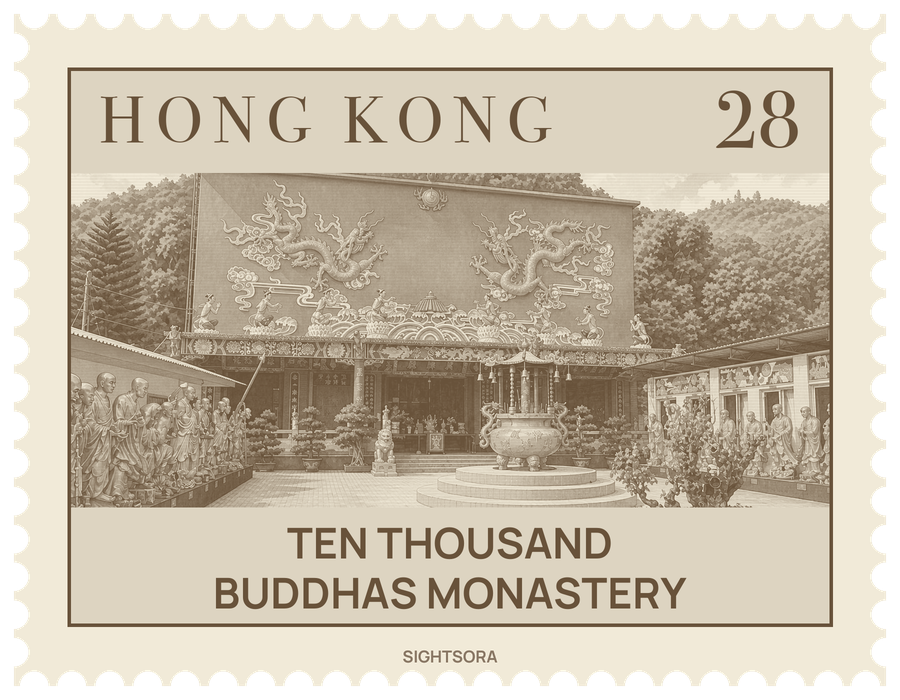
Despite the name, the complex holds more than 12,000 Buddha figures, and despite the word monastery, no monks live here; it is run entirely by lay people.
The Venerable Yuet Kai, who had come to Hong Kong from mainland China in 1938, founded it in 1949 on land donated by a local tobacco company owner. He and his followers built it by hand, carrying materials up from the foot of the hill, with funds raised from lay donors, and it was completed in 1957. Yuet Kai died in 1965, and his preserved body is on display in the main hall.
The arhat statues along the path were made by artists from the Yunnan and Guangdong provinces and are modelled on those of a temple in Kunming, Yuet Kai's hometown. Their installation, begun in 2001 without government approval, caused friction with the authorities over landslide risk, but after a safety assessment they were allowed to stay.
At the top the complex spreads over more than 8 hectares on two levels. The upper level has four halls filled with Buddha statues, honouring Kwun Yam along with other deities of both the Buddhist and Taoist traditions. The lower level holds another hall, two pavilions, a tower and a nine-storey pagoda; the main temple and the pagoda are listed Grade III historic buildings. The monastery also runs a vegetarian restaurant serving traditional Chinese dishes.
In July 1997 a mudslide after days of heavy rain buried the house of the temple's caretaker, who was killed, and the complex was not fully reopened until 31 July 2000, after the slopes around it had been repaired. Film audiences may recognise the temple from the opening scene of the 2002 crime thriller Infernal Affairs, in which a triad boss gathers his young recruits before sending them into the police.