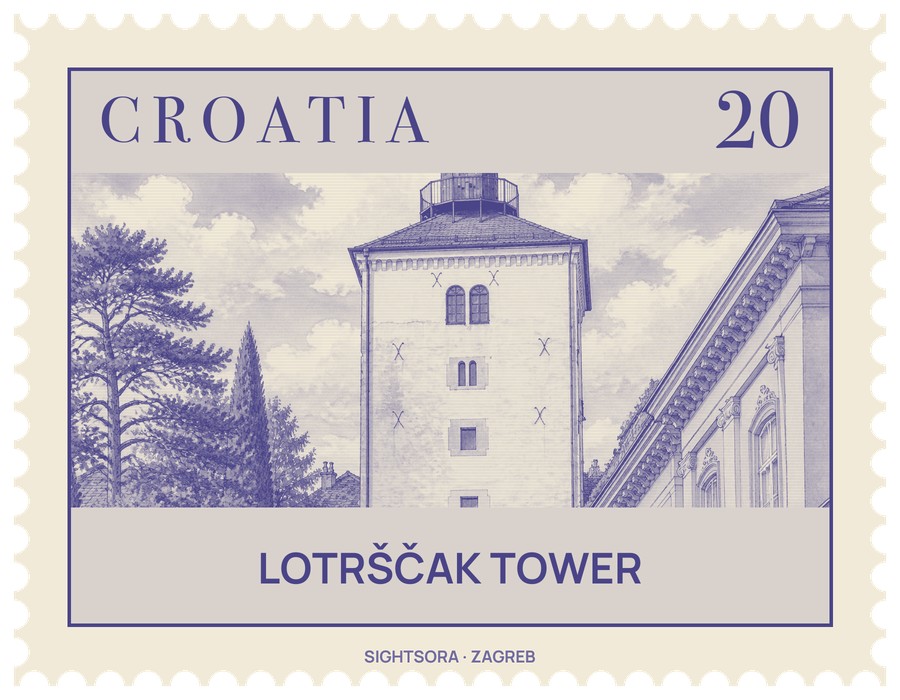
Its name goes back to the Latin campana latrunculorum, the "thieves' bell": from 1646 a bell in the tower was rung each evening to warn that the town gates were about to close. From a window on its fourth floor the Grič cannon is fired every day at exactly noon.
The tower belongs to the defences that Gradec had to build after 1242, when the Golden Bull of the Croatian-Hungarian King Béla IV made it a free royal city in thanks for the shelter it gave him while he fled the Tatars; the charter obliged the townspeople to put up walls and towers, and the work was finished in 1266. The Dverce gate itself was pulled down in 1812 when the southern promenade, the Strossmayer Promenade, was laid out. Old drawings suggest the medieval tower had just two floors, each with two windows, under a four-sided roof, with the entrance on the north side and an outside staircase to the first floor.
Its shape changed with its uses. From the 17th century it served as a commercial store; the city sometimes leased it to private citizens who had to keep it in repair, on condition that it come back to the town if an enemy attacked. In 1857, in the spirit of Romantic restoration, two more floors were added along with a polygonal wooden turret on the roof for watching for fires. In the 19th century a café ran for a while on the ground floor, and the building was later lived in.
The noon gun began as a practical idea: in the late 19th century Zagreb's authorities wanted a daily signal so that the bell ringers of Zagreb's churches could mark midday together. Its first shot rang out on New Year's Day 1877; it fell silent during the First World War and has been fired again since 1927, always from a southern window on the fourth floor. Earlier Grič cannons, the first, second and third, are kept in the Zagreb City Museum. The tower is run by the Klovićevi Dvori Gallery, with an art and gift shop on the ground floor, exhibitions including photographs of Zagreb, and a viewing platform on the upper levels looking out over the city.