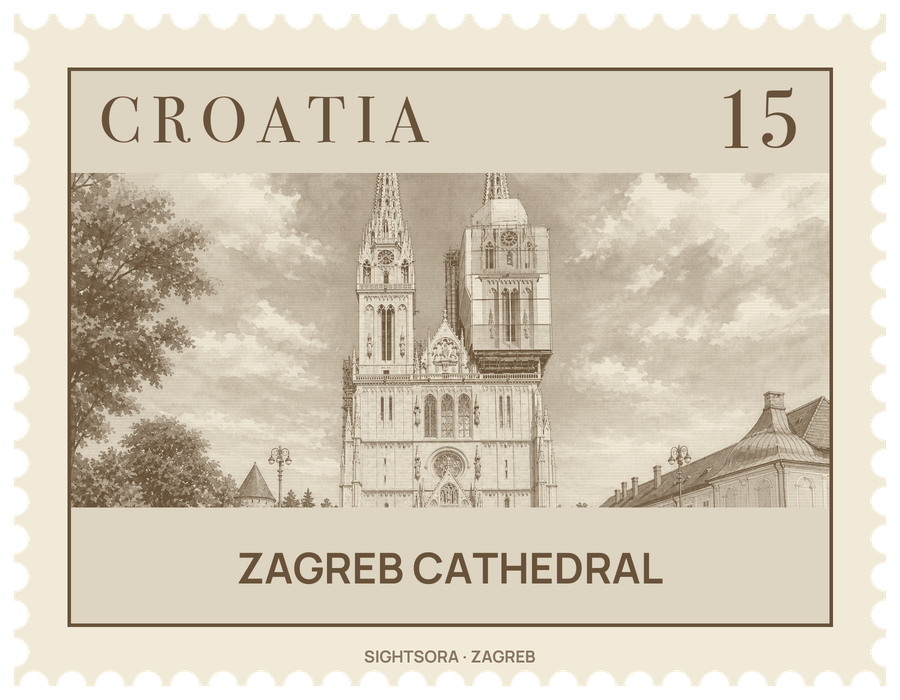
Its patrons are the Virgin Mary, in her Assumption, and two king-saints, Stephen and Ladislav. Zagreb's tourist board calls it the most monumental Gothic sacral building southeast of the Alps, and since 2013 the national Register of Cultural Goods has listed it.
The story starts in 1094, when King Ladislaus founded the diocese of Zagreb and made an existing church on Kaptol its seat. A new cathedral was completed and consecrated by King Andrew II in 1217, while he was heading for the 5th Crusade, but the Tatars burned it in 1242. Bishop Timotej then began a far larger church, raising three polygonal apses and a sacristy whose wall and vault paintings, from the second half of the 13th century, are the oldest in northern Croatia. Against the Ottoman threat, Bishop Osvald Thuz ringed the cathedral with walls; parts of the old Kaptol fortifications still survive around Kaptol, Ribnjak and Opatovina.
Its present look comes from the earthquake of 1880, which brought down the main nave. Hermann Bollé rebuilt the church in neo-Gothic style between 1880 and 1902 and raised the two western towers between 1889 and 1899; each has four clocks set 60 metres up. The tourist board traces the building's mixed ancestry: the plan of three polygonal apses with narrow windows follows a French model, the naves of equal height follow German practice, and the inventive sculpture shows the influence of Czech workshops. High on the facade, at 39 metres, a pediment shows the Mother of God, Jesus and angels, a group by the Viennese sculptor Josef Beyer carved in Zagreb in 1890.
Inside, earlier centuries survive among the neo-Gothic fittings. A baroque pulpit by the sculptor Mihael Cusse still stands in the central nave, and Archbishop Juraj Haulik, who bought a large Walcker organ from Ludwigsburg in 1855, also had the sanctuary windows painted; the tourist board counts them as the oldest stained glass in Croatia. Stone tablets in the niches of the sanctuary list every bishop and archbishop of Zagreb, and a Glagolitic inscription carved in 1942 sits on the belfry wall in the southern nave.
The cathedral is also a national burial place. Ivan Antun Zrinski lies in a tomb behind the main altar beside his father and Fran Krsta Frankopan, and Blessed Alojzije Stepinac, archbishop of Zagreb from 1937 until his death in 1960, rests in a sarcophagus here, with a relief of him and Christ by Ivan Meštrović. The treasury keeps the medieval cloak of St. Ladislaus, an ivory plenarium and a baroque reliquary bust of King Saint Stephen.