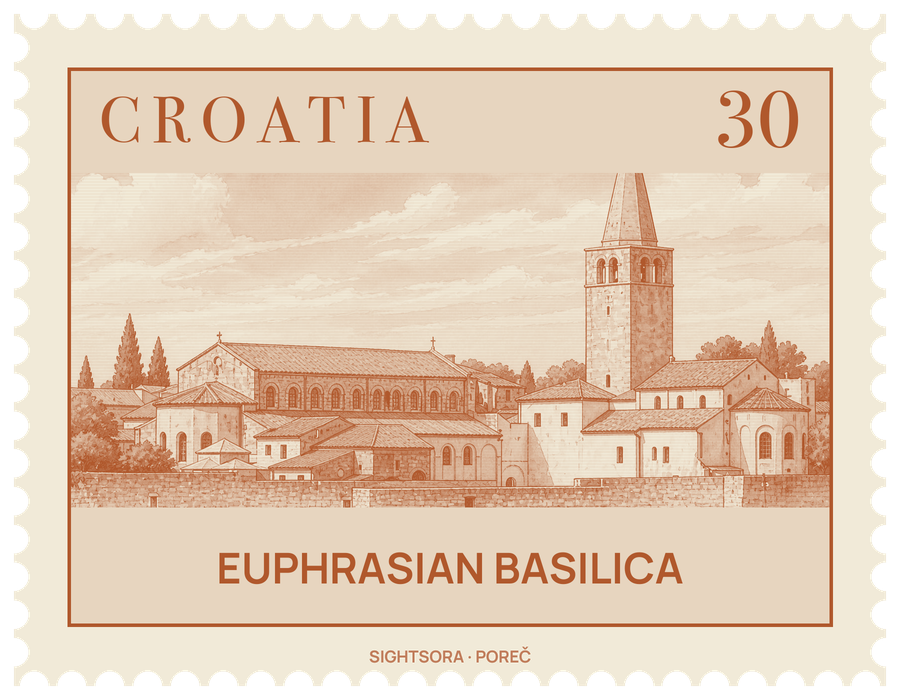
The church is dedicated to the Assumption of Mary and stands at the heart of an episcopal complex that also includes the sacristy, the baptistery and the nearby bishop's palace with its bell tower; the whole group is one of the clearest examples of early Byzantine building in the Mediterranean, and UNESCO inscribed it as a World Heritage Site in 1997.
The present church is the third on the site. The first, dedicated to Saint Maurus of Parentium, went up in the second half of the 4th century, partly inside a large Roman house, and the floor mosaic of its oratory can still be seen in the church garden; coins of the emperor Valens found on the spot help date it. When that building had decayed, Bishop Euphrasius began a new basilica from 553, reusing parts of the old one and bringing marble from the shores of the Sea of Marmara. Byzantine craftsmen made the wall mosaics, local ones the floors, and the work lasted about ten years. Fires and earthquakes changed only details: after the 1440 earthquake the south wall of the nave was repaired and given Gothic windows.
Visitors enter through a colonnaded atrium, built after the church, whose porticoes on all four sides shelter a large collection of carved stone. Around it stand the octagonal baptistery, the 16th-century bell tower, the bishop's palace, of which little of the 6th-century fabric survives, and a trefoil memorial chapel from the 17th and 19th centuries. Inside, eighteen columns of Greek marble divide the nave from the two aisles; their Byzantine and Romanesque capitals are carved with animals and every one bears the monogram of Euphrasius, while stucco decorates the arches between them. The central apse is polygonal on the outside, and each aisle ends in a smaller semicircular apse cut into the wall.
The mosaics are the reason most people come. On the triumphal arch Christ holds an open book reading "Ego sum lux vera" among the apostles, each with his attribute, and below runs a band of medallions with the Lamb of God and twelve female martyrs. In the apse vault Mary sits enthroned with the Child beneath a wreath held by the hand of God, flanked by angels, by Euphrasius carrying a model of his church, by Saint Maurus, the first bishop of Poreč, and by the archdeacon Claudius, all standing in a flowering meadow; a small boy between them is labelled as the archdeacon's son Euphrasius. Between the apse windows are the Annunciation and the Visitation, and the lower walls are faced with stone slabs inlaid with mother-of-pearl around the bishop's throne.
Over the altar rises a marble ciborium of 1277, commissioned by Otto, Bishop of Poreč, and modelled on the ciborium of St. Mark's in Venice; its mosaic canopy rests on four columns kept from the 6th-century ciborium. The church also holds a 15th-century antependium of gilded silver ordered from Italy by Bishop Johann Porečanin, a polyptych by the Venetian painter Antonio Vivarini and a Baroque Last Supper by Palma the Younger, and a votive chapel beside the sacristy holds relics of Saints Maurus and Eleutherius.