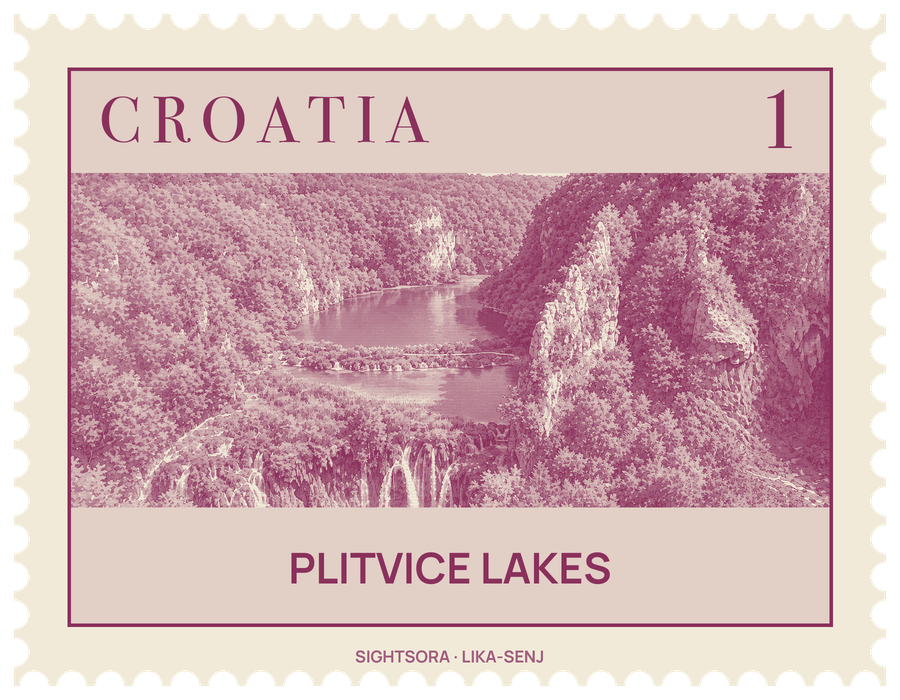
Sixteen lakes lie on the surface, stepping down 133 metres from the first to the last, and their water shifts between azure, green, grey and blue with the minerals and organisms it carries and the angle of the sun. Croatia made the area its first national park in 1949, and UNESCO added it to the World Heritage List in 1979 for the travertine-building processes that shape its lakes.
The lakes owe their existence to tufa, or travertine. Rivers running through the limestone pick up dissolved calcite, and where the water slows, sprays and is aerated over moss, the mineral settles out and builds barriers that hold back the next lake. The moss becomes encrusted and fresh growth pushes further out, so the barriers keep rising, by up to 13 millimetres a year, and older ones can drown beneath newer ones: about 400 years ago Kozjak was still two separate lakes. These processes have only been possible since the end of the ice age, some 12,000 to 15,000 years ago, and the name Plitvice itself comes from the Croatian word for shallow basins.
The system begins in the south, where the Bijela Rijeka and Crna Rijeka meet and flow on as the Matica into Prošćansko jezero. The Upper Lakes sit mostly on dolomite, the Lower Lakes in the north on limestone. Prošćansko jezero and Kozjak are the two largest and deepest lakes, 37 and 47 metres deep, and between them they hold about 80 percent of the water surface. At the northern end, the Plitvica stream drops 78 metres as Veliki slap, the Big Waterfall, and the Korana river carries the water away below a series of further falls.
Many of the falls have names: Labudovac, Veliki Prštavac, the Galovački buk and a waterfall named in 1898 after the opera singer Milka Ternina, who gave money from her concerts to build paths in the park. Tourist routes go back to 1888, when the lakes were first arranged for visitors ahead of a visit by Crown Princess Stéphanie, and two paths still carry the names Štefanijin put and Dorotejin put. Kaluđerovac in the Lower Lakes served as the Silver Lake in the Karl May westerns filmed here between 1962 and 1968.
Forest covers most of the park, and in the virgin woodland of Čorkova uvala in the north-west some beech and fir trees are up to 700 years old. Some 55 species of orchid grow here, and the forests shelter brown bears, grey wolves, lynx, wildcats and eagle owls, while brown trout live in the lakes. The surrounding region of Lika is known for its low wooden houses roofed with rye straw or shingles.