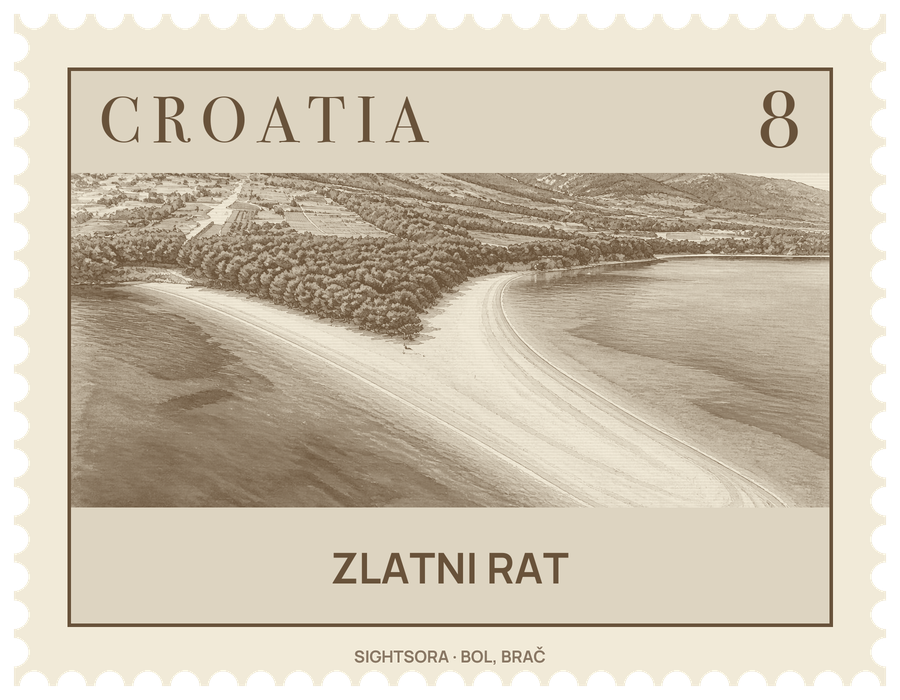
Its name, from the local Chakavian dialect, is usually rendered as the Golden Cape or Golden Horn. A grove of Mediterranean pines covers the inner part of the spit, and the rest is open beach, so visitors can lie on the pebbles on either side and walk out to the point between two stretches of sea.
The spit is protected as a geomorphological phenomenon because its outline never stays fixed. Measured in 2015, its eastern shore ran for 377 metres and its western shore for 479 metres, but tides, currents, waves and wind keep reshaping it. The tip normally leans a little to the east; a strong south-easterly Jugo can swing it west, and in stormy weather it may cross from one side to the other within a few hours. The steady afternoon westerly known as the Maestral tends to hold it straight or bent towards the east.
The two sides feel different. The western water is usually the warmer one, even though it takes most of the afternoon wind and waves, and the reliable Maestral has made the beach a place for windsurfers. Off the tip the current can be mildly hazardous: a swimmer who heads well out to the south, more than 150 metres from shore, may struggle to get back to the western beach, though the usual flow pushes eastwards towards the harbour of Bol and the beaches between the spit and the town.
Among the pines behind the beach lie the remains of a Roman villa rustica, including its swimming pool.