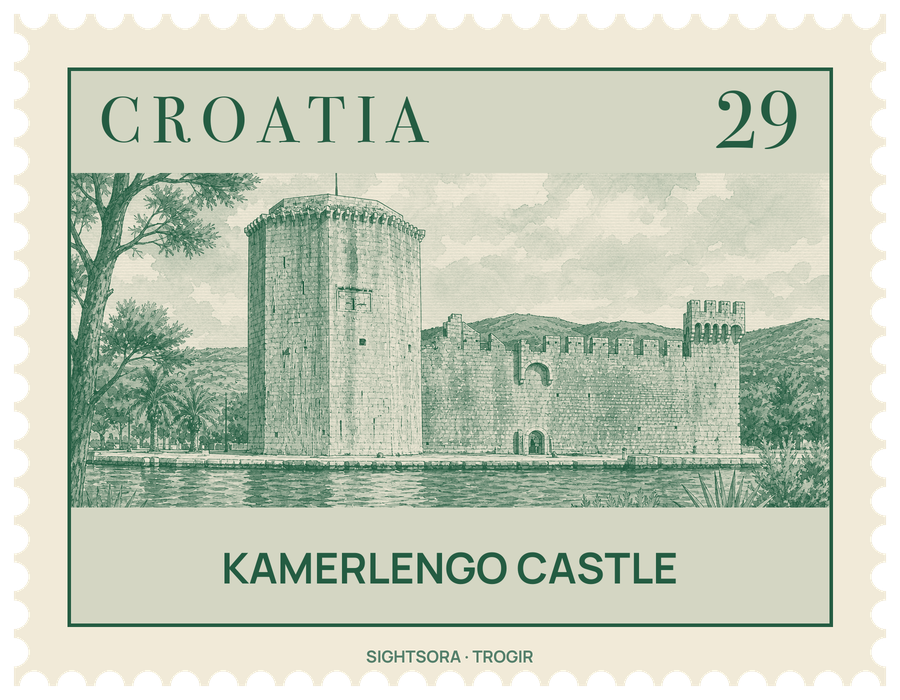
The siege had lasted almost two months, the town's walls were badly damaged and its people did not welcome their new rulers, so the Venetians built a citadel from which to govern them in the 15th century. The work grew out of the Veriga Tower, put up on the spot in the late 14th century; the old corner tower of the town walls became the castle's keep.
The castle housed Venetian mercenaries and their governor, the kamerlengo, a title borrowed from the Italian camerlengo, a chamberlain or administrative official. For a long time it was simply called the castle of Trogir; the name Kamerlengo came into use only from the mid-16th century. At first an outer crenellated wall and a water-filled moat cut it off from the town. In the mid-19th century most of Trogir's walls were pulled down and the moat was filled in, and plans to demolish the run-down castle were stopped.
Inside the walls, a small chapel in the courtyard was dedicated to St. Mark, patron of the Venetian Republic. It carried a Gothic relief of the lion of St. Mark with the initials DC and the arms of the Contarini family, made after the capture of Trogir in memory of Doge Domenico Contarini I, and beneath it a smaller relief with the arms of the Tron family set in a quatrefoil. Luka Tron had distinguished himself as a galley commander when Korčula surrendered and Trogir was besieged, and was then made prince of the town from 1421 to 1424. Today the castle is used as a venue for performances, and from its walls there are views over Trogir.