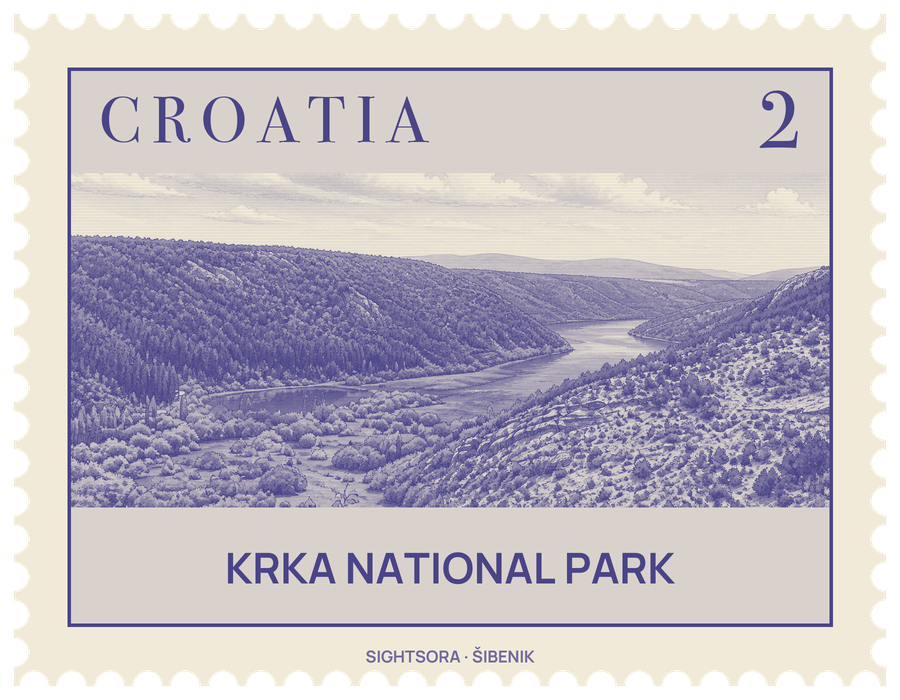
Proclaimed in 1985 as Croatia's seventh national park, it covers 109 square kilometres along the Krka and the lower Čikola, all of it in Šibenik-Knin County. Boardwalks, boat trips, a museum and presentations are part of a visit, and the park also takes in two monasteries.
Skradinski buk, the lowest of the three sets of falls on the river, is the scene most visitors come for. Within a stretch roughly 400 metres long and 100 metres wide, 17 waterfalls drop a combined 47.7 metres, with tall falls at one end of a broad clear pool and cascades at the other. Below it the riverbed was drowned when the Adriatic rose after the last glaciation, creating a ria 23.5 kilometres long in which seawater reaches right to the foot of the falls, and its waters hold shellfish along with both freshwater and saltwater fish.
Further upstream, near Miljevci, Roški slap is the sixth waterfall on the Krka, circled by a walking trail with a separate hiking path nearby. It can be reached by public road, but the simplest approach is on one of the park's own excursion boats. Boat tours from Skradinski buk also go to the island of Visovac, where Franciscans founded the Roman Catholic Visovac Monastery in 1445. Within the park, too, stands the Serbian Orthodox Krka Monastery, founded in 1345 and first recorded in 1402 as an endowment of Jelena Šubić, sister of the Serbian Emperor Dušan; its buildings went on being reworked up to the late 18th century, and it remains a spiritual centre of the Orthodox Dalmatian Eparchy.
The river valley is as much a draw for naturalists as for sightseers. Some 860 plant species and subspecies have been recorded, among them Illyrian-Adriatic endemics such as the Illirian iris that grows on bare rock, and the Krka Waterfalls area is thick with lavender, which brings plenty of bees and wasps. Eighteen fish species live in the river, ten of them endemic, and 222 bird species have been counted, from ospreys, golden eagles and peregrine falcons to griffon vultures and bee-eaters, along with 18 species of bats and the European otter. Near the park lie the remains of fortresses from Roman times at Čučevo, Nečven, Bogočin, Ključica and Burnum.