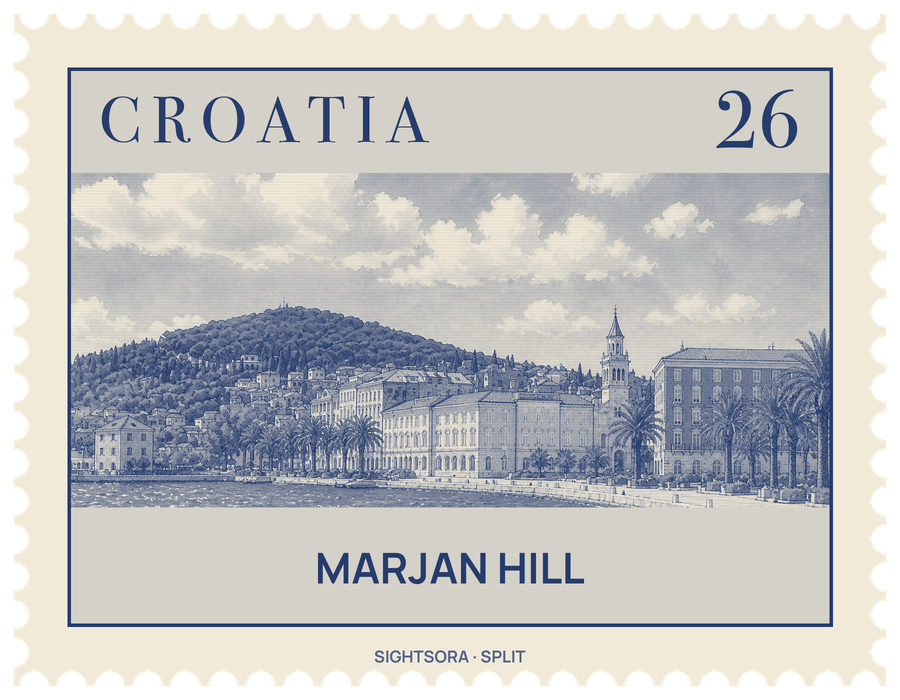
From the top the view takes in the whole of Split, the nearby islands and the mountains of Mosor and Kozjak. Diocletian's Palace is only a few minutes' walk away, and a long flight of steps runs from the hill's look-out points down to the palace, the Riva and the old centre. Around its foot lie the beaches of Obojena, Kašjuni and Bene, while jogging trails and tennis courts run through the woods and the Institute of Oceanography and Fisheries occupies the tip of the peninsula.
The hill has been a park for Split's people for a very long time; Diocletian is said to have set aside the slopes nearest his palace for the recreation of its residents. Several old sites stand among the trees. The small, rustic church of St. Nicholas, a saint dear to Split's many fishermen, dates from the early 13th century. A walk of two and a half kilometres along the southern rim path leads to the 15th-century church of St. Jerome, with an altar carved by Andrija Aleši, and a group of Renaissance hermit caves, in use from the 15th century, is cut into the cliff clefts just above and behind it. Above the city on the eastern side of the hill lies the Old Jewish Cemetery, founded in 1573, with over 700 graves and legible tombstones from the eighteenth to twentieth centuries; it was closed in 1945 and protected as a monument.
Much of the forest is younger than it looks. Large parts of the hill were bare until the first planting of Aleppo pine in 1852, in the Jewish cemetery, followed from 1884 by systematic afforestation led by Professor Juraj Kolombatović, who in 1903 founded the Marjan Association; its members built roads, paths, belvederes and, in 1924, an approach to the first peak of 378 white stone steps. In the 1950s the whole hill was turned into a forest park, with jogging tracks, a road circling the peninsula and the look-out points known as vidilice. Marjan was declared an area of Special Protected Nature in 1964; a 10-metre white cross was unveiled beside the platform on its highest peak in 2013, and a 19-metre observation deck opened on the second-highest peak in 2024.
The hill has a place in Split's identity too. During the Second World War local Partisans sang "Marjane, Marjane", reportedly a favourite of Josip Broz Tito, who later chose Marjan for the Vila Dalmacija, the summer residence of the Yugoslav president. On the south side, the former villa of the sculptor Ivan Meštrović houses the Meštrović Gallery.