The largest, Veli Brijun, covers 5.6 square kilometres and lies 2 kilometres from shore; Mali Brijun, the second largest, is about 1.07 square kilometres, and the other twelve are far smaller. The islands mix parkland, Mediterranean woods and archaeological remains with the traces of a century as a resort and a presidential retreat.
For much of their history the islands were known for their stone. Under Venice, Brijuni quarries supplied material for the city's palaces and bridges, and in Austrian times stone went to Vienna and Berlin, while the navy built Fort Tegetthoff on Veli Brijun to guard the harbour of Pula. In 1893 the Viennese industrialist Paul Kupelwieser bought the whole archipelago and set out to make it an exclusive seaside resort; he brought in the microbiologist Robert Koch to fight malaria, and by 1901 the island was declared free of it. Hotels, parks, vineyards and a yacht harbour followed, and the islands became a meeting place for Vienna's upper class.
After 1945 the islands passed to Yugoslavia and became Josip Broz Tito's official summer residence, with a pavilion designed for him by the Slovenian architect Jože Plečnik. Nearly 100 foreign heads of state came to see him here, along with film stars such as Elizabeth Taylor, Richard Burton and Sophia Loren. In July 1956 Tito met Gamal Abdel Nasser of Egypt and Jawaharlal Nehru of India on Brijuni, and the ideas they set out grew into the Non-Aligned Movement. Tito died in 1980, and in 1983 the islands were made a national park; in 1991 they also gave their name to the Brioni Agreement.
Veli Brijun holds much of what visitors come to see. At four sites on the island more than 200 dinosaur footprints from the Cretaceous have been found. Archaeological remains span a Bronze Age hill-fort going back to the 14th century BC, two Roman villas from the 2nd century BC, a Byzantine fort and the 13th-century church of St. Mary, built by the Knights Templar. An exhibition devoted to Tito uses photographs to document over a hundred official visits by heads of state, with a floor of stuffed animals from the island's zoo below it and a room given over to Paul Kupelwieser, and a museum in the old boathouse covers the other islands, their nature and their earlier inhabitants.
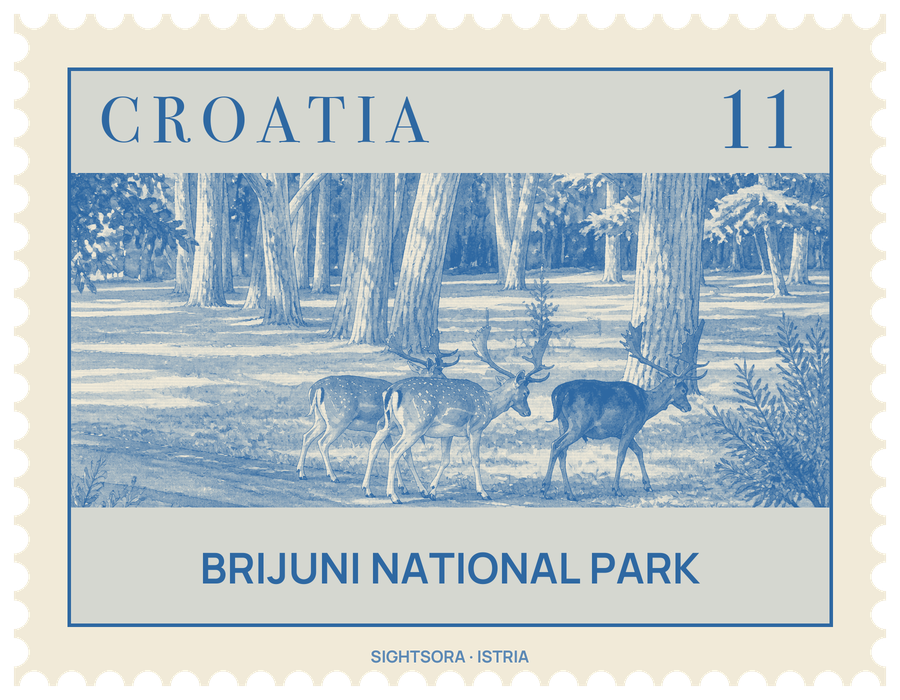
Tito's diplomatic gifts still shape the island's wildlife. A safari park keeps animals presented by foreign leaders, among them nilgai, zebu and Asian elephants from India, including the elephants Sony and Lanka given by Indira Gandhi, zebras sent by Ahmed Sékou Touré of Guinea and waterbuck from Ethiopia, and an ethno park beside it shows a traditional Istrian farmstead with the region's own breeds: the Istrian ox, Istrian sheep, donkeys and goats. Chital, fallow deer and mouflon, brought over in the early 20th century, roam freely through the woods and meadows. Veli Brijun has around 600 native plant species alongside acclimatised cedars, bamboo and exotic plants given to Tito, and the marshy area of Saline, with three small lakes, is a refuge for birds; dolphins and sea turtles are sometimes seen in the surrounding waters.