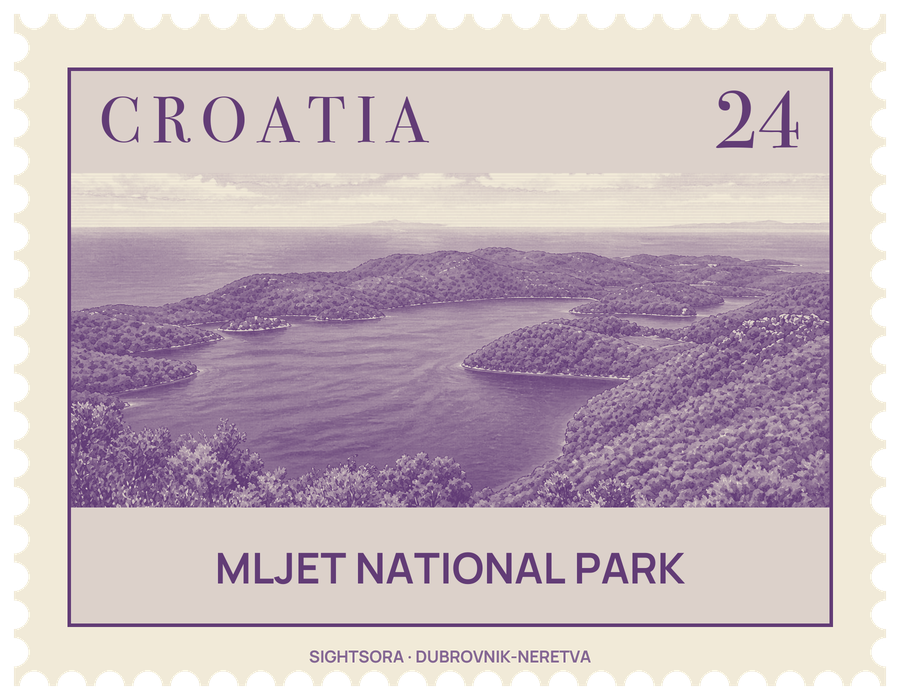
They are the heart of Mljet National Park, founded on 11 November 1960 with the help of the researcher Branimir Gušić. The park covers almost 5,300 hectares, roughly a third of the island, including Soline Bay and a belt of sea 500 metres wide off the coast, and the park authority treats the two lakes as an important geological and oceanographical phenomenon.
The Small Lake reaches furthest inland and is joined to the Great Lake by a narrow, shallow channel in which the water flows back and forth with the tides. In the 30s of the 20th century a stone bridge, Mali most, replaced the stepping stones people used to cross it while livestock waded through. The Great Lake in turn meets the open sea through the Soline channel, where the Benedictines once had a watermill; the old bridge and mill were pulled down in 1958 to let larger boats into the lake. A promenade named after Branimir Gušić runs around the Great Lake, and footpaths link both lakes with the villages of Polače and Pomena.
The Isle of Saint Mary, out in the south of the Great Lake, is half a hectare in size and holds a Benedictine monastery and the Church of Saint Mary, the most visited place in the park. The monks built the monastery between 1177 and 1198, the year a document of Pope Innocent III consecrated the church. The church is a single-nave Romanesque building in the Apulian manner, modelled on the original Benedictine house at Monte Gargano; later Renaissance and Baroque changes left its central part Romanesque, and a defensive tower turned the whole complex into a fortress. The monastery was closed under Napoleon's rule in 1809, served as a hotel from 1960 to 1991 and was returned to the Diocese of Dubrovnik in 1998.
Polače, the oldest settlement, grew among the walls of a Late Antiquity palace built near the end of the 5th century and gave the village its name. Four islets, Tajnik, Ovrata, Kobrava and Moračnik, shelter its bay, and around it lie remains of Roman country villas and baths, an early Christian church and, on the hill, the Kaštijo watchtower that guarded the harbour against pirates. Pomena grew from a fishing community and became the main arrival point for organised groups. Goveđari, settled under an agreement with the monks in 1793, is protected as a well-preserved traditional village. From the hilltops of Montokuc and Veliki Sladin Gradac the whole park can be seen, along with Pelješac and the sea towards Korčula and Lastovo.
Getting there
Boats run to Mljet from Dubrovnik, Split and Pelješac, and most excursion boats berth at Polače or Pomena, both linked to the lakes by footpaths. A boat to the Isle of Saint Mary leaves from the jetty at Mali most.