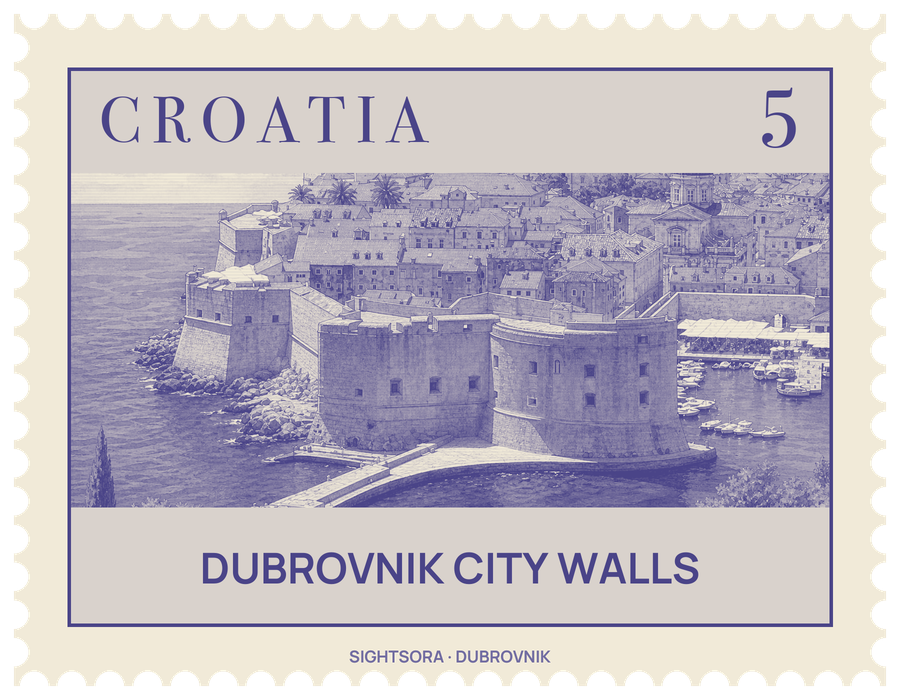
Most of what stands was built between the 13th and 17th centuries, with the busiest period from the early 15th to the later 16th century, when the independent Republic of Ragusa hired Italian and Croatian architects to keep pace with the Ottoman threat. The walls are so solid that the strong earthquake of 1667 left them largely unharmed. In 1979 the old city, walls included, joined the UNESCO World Heritage list.
Along the way the circuit passes three round and 14 square towers, five bastions, two corner fortifications and St. John's Fortress, and the walls were once armed with more than 120 cannons. On the landward side they are 4 to 6 metres thick and backed by sloping walls built against artillery; facing the sea they range from 1.5 to 5 metres. The high point to the north is the round Minčeta Tower, designed by Michelozzo and finished by Giorgio da Sebenico in 1464, which came to stand for a city no enemy could take. Below it, a 16th-century cannon foundry found after a long excavation is now a museum.
The Pile Gate on the west is the old town's principal gateway. A stone bridge between two Gothic arches, designed by Paskoje Miličević in 1471, leads to a wooden drawbridge over the old moat, now a garden, and a statue of Saint Blaise holding a model of the city stands above the arch. Under the Republic the drawbridge was raised every night and the keys handed to the rector. Just inside the inner Gothic gateway is one of the three access points to the walls. The rounded Fort Bokar, built by Michelozzo between 1461 and 1463, guards this side.
At the eastern end, the Ploče Gate is covered by the freestanding Revelin Fortress, rebuilt to designs by Antonio Ferramolino approved in 1538; it took 11 years, and all other building in the city stopped until it was done. Between the two gates lies the old harbour, where three great arches of the Arsenal open onto the water, the Fishmarket Gate of 1381 and the Ponte Gate of 1476 lead into town, and the Kaše breakwater of 1485 shelters the anchorage. On the harbour's south-eastern side, St. John's Fortress has an aquarium of Adriatic fish on its ground floor and a maritime museum above.
Outside the western walls, Fort Lovrijenac stands on its rock 37 metres above the sea with the motto "Non Bene Pro Toto Libertas Venditur Auro" over its gate. The walls themselves have been tested by many sieges, from the Saracen siege of 866–867 to the Yugoslav army's bombardment of 1991–1992, when projectiles struck 563 of the old town's 824 buildings; the ancient walls held up better than many modern structures outside them.