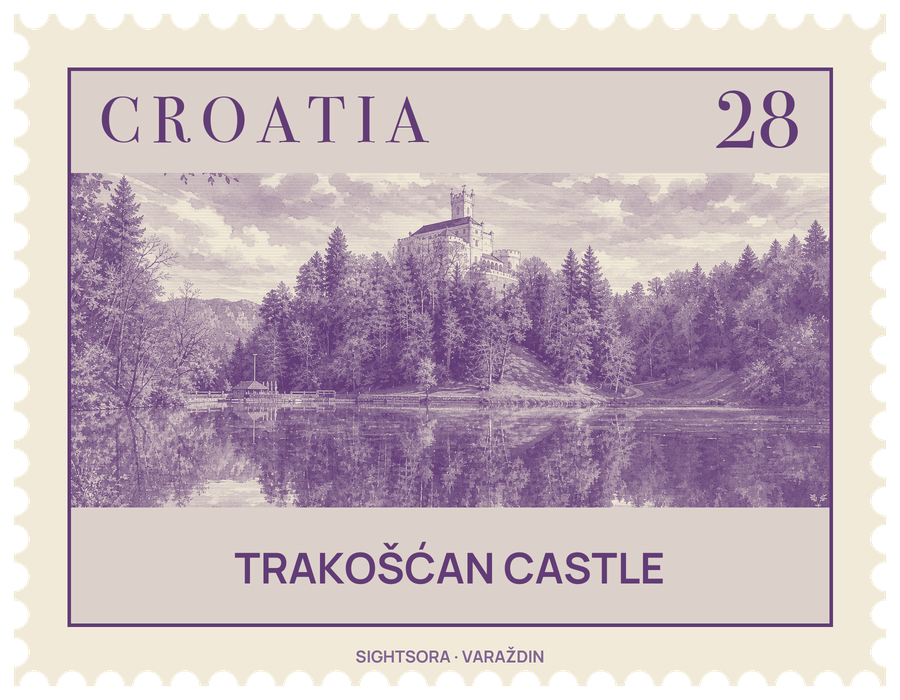
Croatia protects the whole ensemble, the castle, the buildings around it, the park-forest and the lake, as cultural property of national importance. Inside is a museum, opened in 1953, whose permanent collections tell the story of the Drašković counts who lived here for centuries.
The core goes back to the 13th century, when a small Romanesque watch fort was built here as part of the defences of north-western Croatia to keep an eye on the road from Ptuj to the Bednja valley; the name Trakošćan first appears in writing in 1334. Its early owners are unknown. By the end of the 14th century it belonged to the Counts of Celje, and after that line died out it passed through several hands, including Jan Vitovac, Ivaniš Korvin and the Gyulay family. In 1584 King Maximilian's grant to Juraj Drašković finally made it the property of the Drašković family.
For centuries the castle was first of all a fortress, and its building history shows it. The oldest part is a living block, a small fortified courtyard and a tall, massive tower; as firearms improved and Turkish raids grew more dangerous, a coat of arms and inscription show that the western tower was the work of Ivan II and Petar, the family's second generation. The Great Genealogical Tree of 1668, the earliest picture of the castle, already shows three floors, and in the 18th century outbuildings went up at the foot of the hill along with a stone bridge over the Bednja.
When manor houses became the fashion in Hrvatsko Zagorje in the later 18th century, the family left Trakošćan and it fell into decay. Interest returned in the mid-19th century in a Romanticist spirit: the castle was rebuilt in Neo-Gothic style, ending some five hundred years as a fortress, and became a residence. To pay for the work, Count Drašković sold Klenovnik Castle. The grounds were laid out as Romanticist pleasure grounds on the English model, following plans by Franz Risig, and a dam turned the valley into the lake that now mirrors the castle. Later the family added the northern tower over the entrance and a vaulted terrace on the south-west side.
The Drašković family stayed at the castle from time to time until 1944, when they were forced to leave for Austria, and it was soon nationalised; today it belongs to the Republic of Croatia. Visitors can tour the rooms of the castle and then walk the landscape park, where the lake, meadows and groups of trees and shrubs were designed to work together as a single garden.