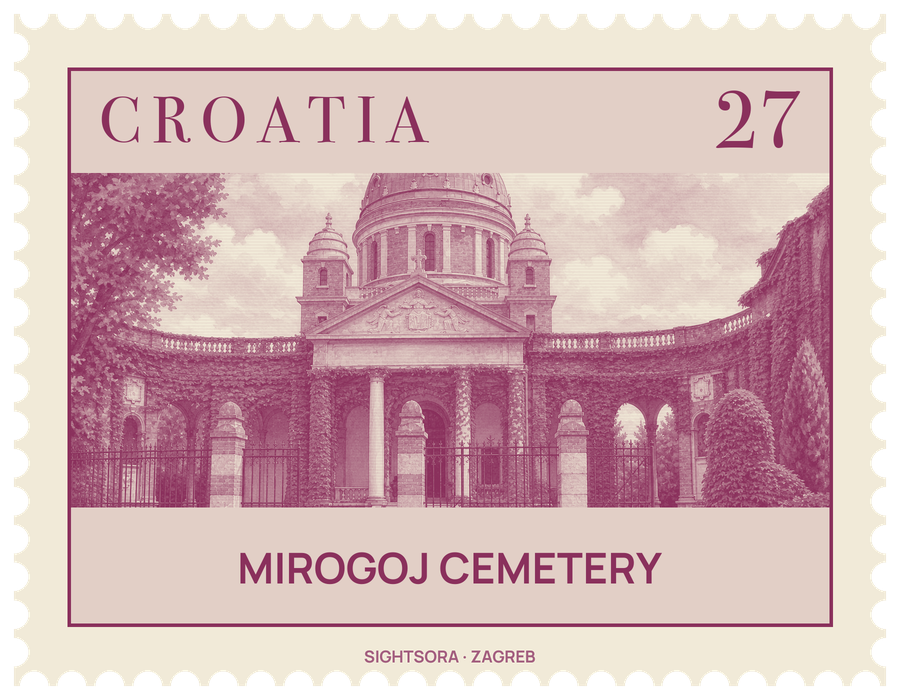
The main building was designed by the architect Hermann Bollé, who is himself buried here. The cemetery opened on 6 November 1876 on land that had belonged to the linguist Ljudevit Gaj and was bought by the city after his death in 1872. Work on the arcades, the cupolas and the entrance church started in 1879, but money ran short and it was finished only in 1929.
Zagreb's older cemeteries had belonged to the Church; Mirogoj was owned by the city and from the start accepted burials of every faith. Catholic, Orthodox, Muslim, Jewish, Protestant and Latter Day Saints graves lie here alongside those of people with no religion, and the arcades hold the tombs of many well-known Croats.
Among those resting at Mirogoj are Ljudevit Gaj, the writers August Šenoa, Antun Gustav Matoš, Miroslav Krleža and Ivana Brlić-Mažuranić, the poet Tin Ujević, the composers Vatroslav Lisinski and Ivan Zajc, the inventor Slavoljub Eduard Penkala, the seismologist Andrija Mohorovičić, the Nobel Prize-winning chemist Vladimir Prelog, the basketball player Dražen Petrović, the politician Stjepan Radić and Franjo Tuđman, the first president of Croatia. Memorials across the grounds mark the losses of the 20th century, among them a monument to Croatian soldiers who fell in the First World War, a memorial to the children of Kozara, the Tomb of the People's Heroes and the "Wall of Pain" for Croatian victims of the War of Independence; there is also a German military cemetery.
Getting there
The cemetery sits between Mirogojska road and Hermann Bollé street. City (ZET) bus 106 links Mirogoj with Kaptol, the bus terminal in the heart of Zagreb; lines 203, which continues east to Svetice near Maksimir Park, and 226, which goes by way of Remete, also start at Kaptol and follow a similar route.