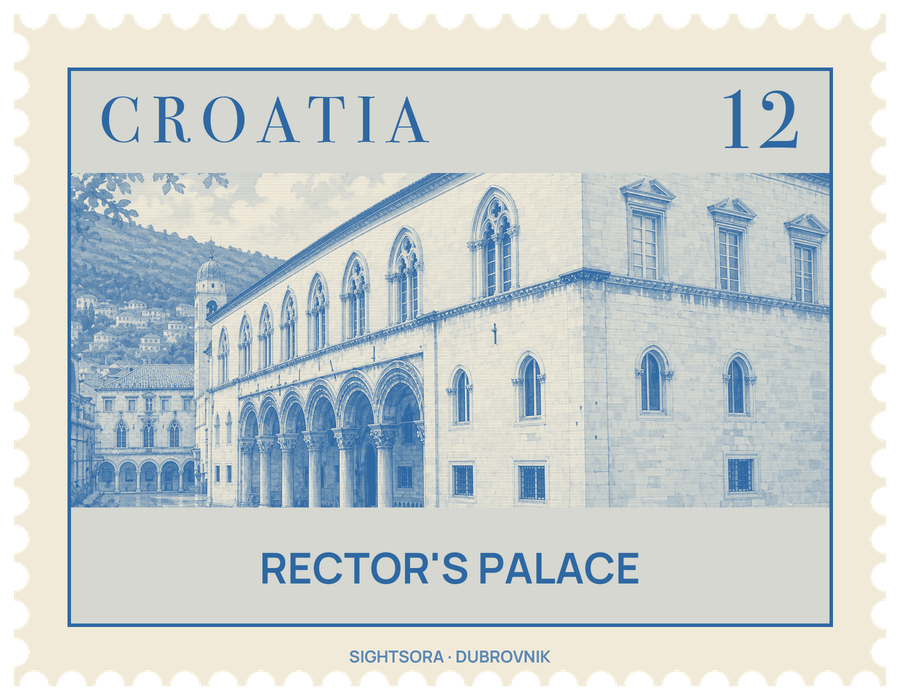
Under one roof it held the rector's residence, the Minor Council and the state administration, along with an armoury, a powder magazine, a guardhouse and a prison. Since 1872 the palace has been home to the Museum of Dubrovnik's History Department.
Its appearance records a run of disasters and rebuildings. An early medieval defensive building on the site burned in 1435, and the Republic hired Onofrio della Cava of Naples, the builder of the city's aqueduct, to raise a new Gothic palace, its carved ornament the work of Pietro di Martino of Milan. In 1463 an explosion of stored gunpowder left it badly damaged; Michelozzo of Florence was asked to restore it but was turned down in 1464 because his design leaned too far towards the Renaissance. Other builders carried on, and from 1467 the porch capitals were reworked in the Renaissance manner, most likely by Salvi di Michele, who came from Florence.
Earthquakes struck again in 1520 and 1667, and the repairs that followed were Baroque, adding a staircase and a bell to the atrium. The result mixes Gothic, Renaissance and Baroque features in one building. In 1638 the Senate placed in the palace a monument by Pietro Giacometti of Recanati to Miho Pracat, a wealthy shipowner from Lopud who had left his fortune to Dubrovnik.