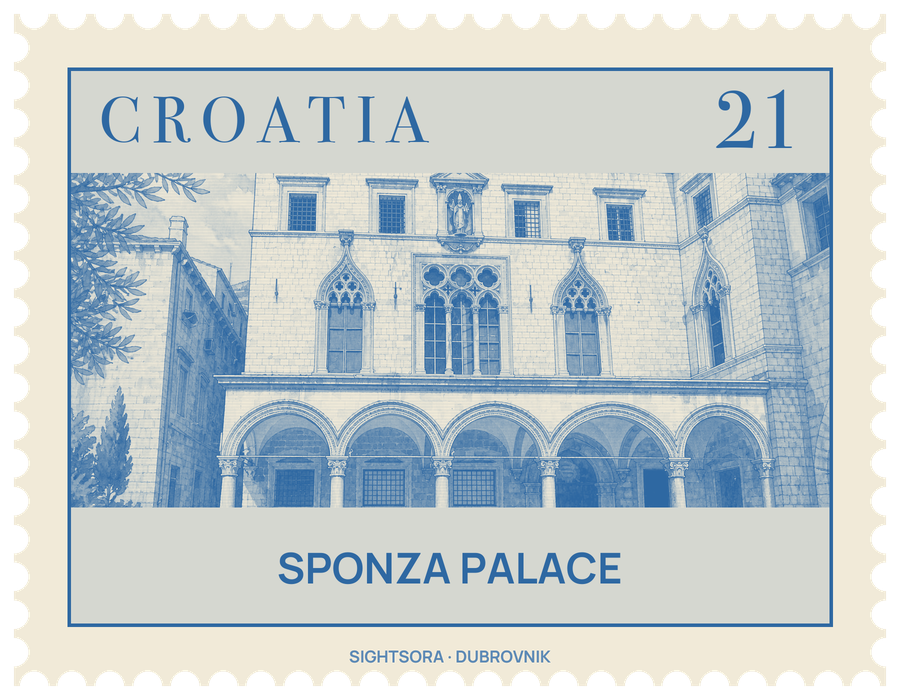
Its name comes from the Latin spongia, the place where rainwater was gathered, and it is also called Divona, from dogana, the word for customs.
For centuries the palace did the public business of the Republic of Ragusa. It housed in turn a customs office and bonded warehouse, the mint, an armoury, the treasury, a bank and a school, and its atrium worked as a trading floor where merchants met; a Latin inscription on one of the arches records that role. In the 16th century the literary academy Academia dei Concordi was founded here, turning the building into the cultural centre of the republic. The palace came through the 1667 earthquake without damage.
The building holds the Dubrovnik State Archive, which moved here from the Rector's palace: more than 7000 volumes of manuscripts and some 100,000 individual manuscripts. Performances are staged inside the palace, and the Luža square in front of it is where the Dubrovnik Summer Festival opens each year. The courtyard also has a second life in computer graphics: the "Sponza Atrium" 3D model, first made for a rendering contest, became a widely used test scene for lighting simulation.