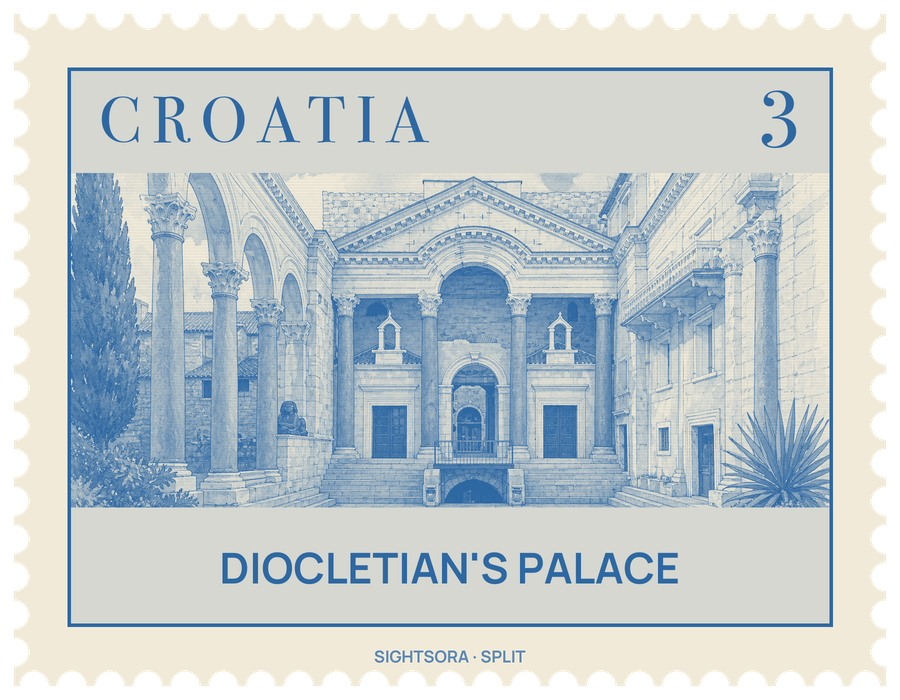
Diocletian had the fortified compound built on a peninsula six kilometres from Salona, the capital of Dalmatia and his birthplace, and moved in after giving up the throne on 1 May 305. Roughly half of it was his private residence; the rest housed a military garrison. In 1979 UNESCO put the palace, together with the historic core of Split that grew up around it, on its World Heritage register.
The palace survived because people moved into it. When Avars and Slavs largely destroyed Salona in the 7th century, refugees took shelter behind its walls, and the complex has been lived in without a break ever since, with homes and businesses built into the basements and the walls themselves. Between the 12th and 14th centuries medieval houses filled the Roman buildings and much of the open street space. In 1764 the Scottish architect Robert Adam published measured drawings of the ruins, and the palace went on to shape his Neoclassical style.
In plan the palace is an irregular rectangle, its eastern side 214.97 metres long and its northern side 174.74 metres, with towers along the three walls facing the mainland, much like a legionary fort. Each wall had a gate in the middle. The North Gate, or Golden Gate, opened onto the road to Salona and was probably the emperor's own entrance; the 7th-century church of St Martin sits in the guard corridor above it. The West Gate is the only one that has stayed in use without interruption, and a cross carved by Christians in the 5th century replaced a relief of Nike on its lintel. The small South Gate once led straight from the sea into the basement rooms below the imperial apartments.
An east–west street splits the interior in two, and the main street from the Golden Gate runs south to the Peristyle, the monumental colonnaded court that led to the emperor's quarters through the Vestibule. On its east side Diocletian's octagonal mausoleum is the Cathedral of Saint Domnius, with a Romanesque bell tower completed in the medieval commune period. To the west, the temple of Jupiter, built between 295 and 305 and never quite finished, became a baptistery, probably in the 6th century. Diocletian brought twelve granite sphinxes from Egypt, about 3,500 years old; three survive, one still on the Peristyle, a headless one in front of Jupiter's temple and the third in the city museum.
The emperor's apartments stretched along the seafront, joined by a long gallery that looked out to sea through 42 windows and 3 balconies. Little of the upper floor stands, but the barrel-vaulted cellars beneath it are almost complete, so their walls trace the layout of the rooms that once rested on them. The palace was built mainly of white limestone and marble from the island of Brač, with Egyptian granite columns brought in for decoration. Scenes for the fourth season of Game of Thrones were filmed here.