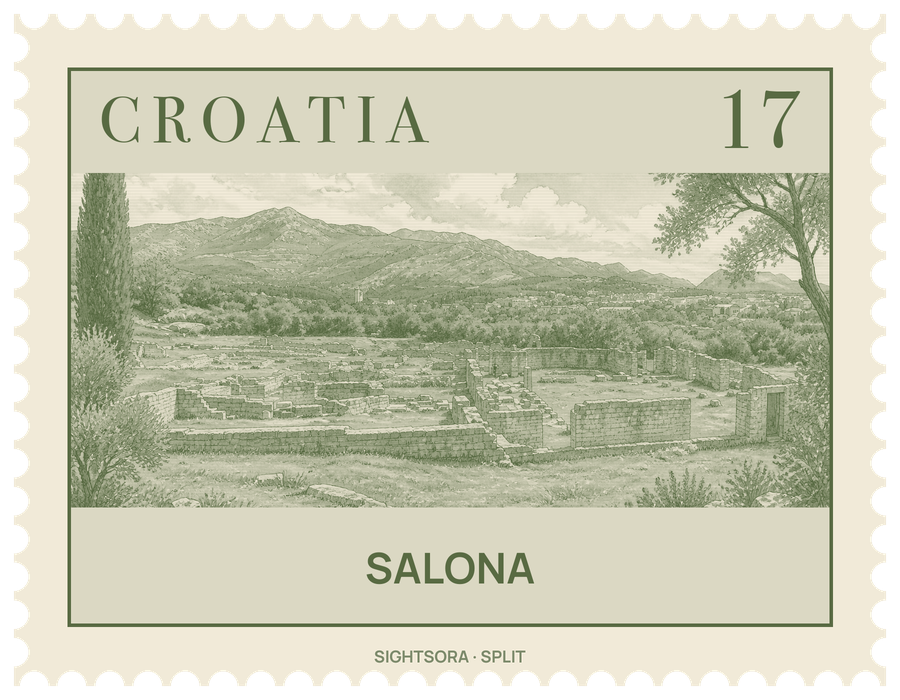
Founded in the third century BC, it grew in the late Roman Empire into a city of tens of thousands of people; Emperor Diocletian was born here, and the last Western emperor, Julius Nepos, made it his final residence, so that between 476 and 480 it served in practice as the capital of the Western Roman Empire. Invading Avars and Slavs largely destroyed it in the seventh century, yet walls, a forum, a theatre, an amphitheatre, baths and an aqueduct can still be traced on the ground.
The oldest core lay around the forum, a square of 45 by 70 metres, and the theatre, entered from the north-east through the Porta Caesarea. This gate keeps its two octagonal towers and three passages: a wide central one for carts, probably closed by a movable grille judging by grooves in the side piers, and a narrower one for people on each side. Once the city outgrew it, the gate was put to use carrying the aqueduct that Augustus had built to bring water from the river Jadro; that channel ran for 3,850 metres, and its best-preserved stretch lies north of the episcopal centre. Around 170 AD, under Marcus Aurelius, the walls were extended to take in the eastern and western suburbs, forming an ellipse about 4 km round with at least 90 towers; triangular fronts added to some square towers in the sixth century can be seen on the north side of the Urbs orientalis.
Salona was also a key early Christian city, and its churches made it a major site for the study of Christian architecture. In the northwest of the eastern town stands the episcopal centre of the fifth century, with twin basilicas, a baptistery and a bishop's palace. Burials were forbidden inside Roman walls, so cemetery churches grew up outside them: at Manastirine, where Saint Domnius, bishop and martyr, was laid to rest after being executed in the amphitheatre in 304, a three-aisled basilica of the mid-fifth century rises among numerous sarcophagi; Kapljuc holds the remains of the oldest cemetery basilica, built over the graves of four Praetorian guards; and Marusinac grew around the martyr Anastasios.
In the east of the city, the Great Thermae, from the second or early third century, show how a Roman bath worked: a cold room with a semicircular pool, two changing rooms with benches and wall openings for clothes, a massage room, a hall for rest and exercise, and the hot rooms, the caldarium, tepidarium and sudatorium. At the far western edge stood the amphitheatre, raised on a natural slope in the later second century and measuring 125 by 100 metres; it could seat between 15,000 and 18,000 spectators, and beneath its southern seating two vaulted rooms served the gladiators' worship of Nemesis. Only its substructures and fragments survive, because the Venetians pulled it down in the seventeenth century during the wars against the Turks.
After the fall, refugees moved into Diocletian's Palace, six kilometres away, which became the core of Split, and the Archaeological Museum of Split now keeps many fine marble sarcophagi from the Salona cemeteries, along with mosaics of Apollo Orpheus and Triton from the governor's villa near the Porta Caesarea. The Slavic newcomers settled east of the ruins by the Jadro, and Croatian kings of the tenth and eleventh centuries built churches here: St. Stephen's became a royal mausoleum, where the sarcophagus of Queen Helen was found, and the Basilica of St. Peter and Moses, known as the Hollow Church, saw the coronation of King Demetrius Zvonimir in 1075. Architectural fragments from the site are displayed at the Tusculum, a building of 1898.