In 2017 its beech forests joined a UNESCO World Heritage Site that groups old-growth and primeval beech woods of the Carpathians and other parts of Europe, valued for what they show about how forests across Europe have changed since the last Ice Age.
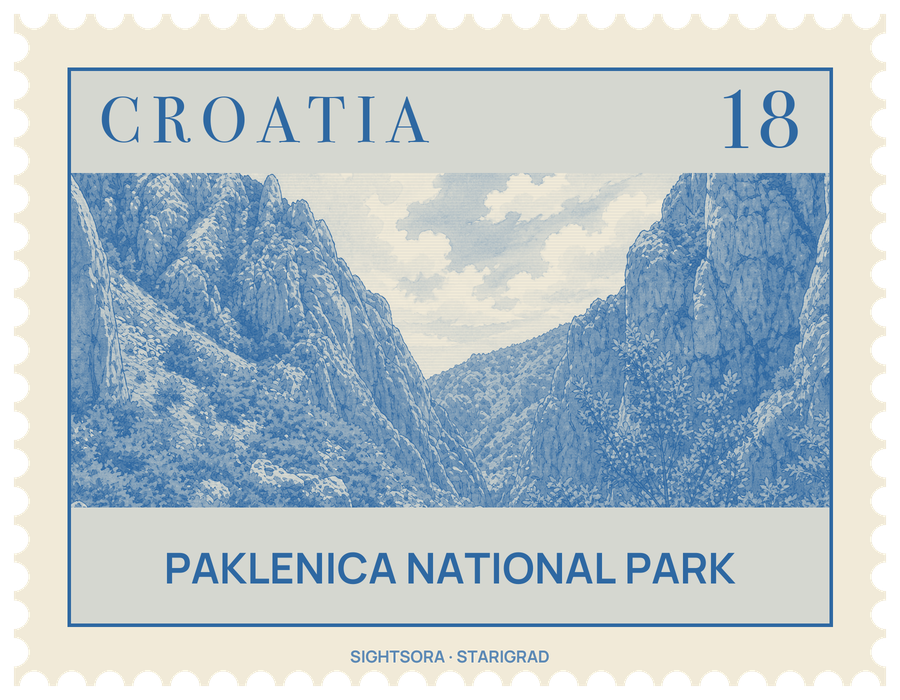
Velika Paklenica is the larger gorge, running for 14 km with a width of 500–800 m; it closes to only 50 m around the Bunkers, while its walls rise more than 700 m. The most dramatic stretch is below Anića luka, where sheer cliffs stand straight above the stream down towards the parking lot. Mala Paklenica, with a weaker stream, measures 12 km in length and 400–500 m across, squeezing to just 10 m at one point between cliffs up to 650 m high. Close to the entrance of Velika Paklenica is a man-made tunnel complex dug for Josip Broz Tito in the late 1940s and early 1950s, at the time of tension between Yugoslavia and the USSR.
Beyond the canyons, the centre of the park is the high ground of Borovnik and Crni vrh, named for its black pine forest, with the bowl-shaped valley of Velika Močila at 850 m; to the east the land grows wild and hard to reach before softening into the pitted karst plateaus of Malo and Veliko Libinje. Along the top runs the narrow Velebit ridge, 1 to 3 km wide, which includes Vaganski vrh, the mountain's highest peak. Explorers have mapped 76 underground features in the park, 39 pits and 37 caves, and good drinking water comes from permanent springs, among them Pećica, Crno vrilo, Kontinovo vrilo, Stražbenica and Velika Močila.
Walking is the way to see Paklenica: some 150–200 km of trails, marked with boards and mountaineering signs, range from tourist paths up Velika Paklenica to the Manita peć cave, to Lugarnica, a forest cottage, and on to the mountain hut, to routes for mountaineers heading to Velebit's highest summits. The canyon walls are also a major climbing ground with hundreds of equipped routes; the great face of Anića kuk carries long climbs such as the 350-metre Brid Klina, first climbed over eight days in 1973.
About 1,000 plant species and subspecies have been recorded, 79 of them endemic, in forests of oak and oriental hornbeam, beech and black pine. Birds are the richest group, with 230 species, among them a community of 24 species nesting on the canyon cliffs and rare birds of prey: the goshawk, the golden eagle, the short-toed eagle and the peregrine falcon; the 53 mammal species include roe deer, chamois and the brown bear, and the endangered Orsini's viper lives here too. People have used the area since prehistory: ring-shaped stone mounds known as gromile mark Bronze Age Liburian hillforts, in Tribanj near Sveta Trojica and above Modrič stand ruined forts built under Justinian, and early Croatian chapels survive at Rovanjska and Starigrad.