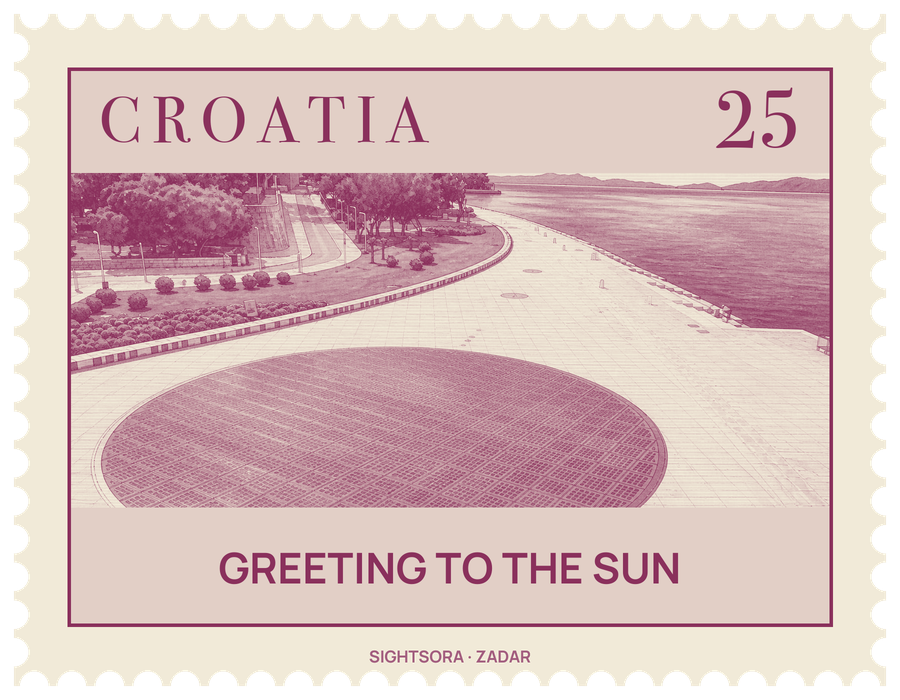
Under the glass lie photovoltaic solar modules fitted with lights, which switch on after dark and play a light show across the circle. The Croatian architect Nikola Bašić designed it, along with the nearby Sea organ; one speaks with sound, the other with light.
The large circle stands for the Sun, and smaller installations nearby represent the planets of the Solar System. Their sizes and their distances from the centre are each kept in proportion, though on different scales, since the real planets are so far apart. Each planet has a ring carrying its name in Croatian and its astronomical symbol.
A chrome ring around the Sun turns the monument into a calendar. It is inscribed with the names of the titular saints of the churches on the Zadar Peninsula and their feast days, and for each date it gives the solar declination, the Sun's altitude and the length of daylight at the waterfront. The data were prepared with Professor Maksim Klarin of Zadar Maritime School, who also programmed the times the light show starts and ends for 50 years from 2008. During the day the solar modules feed the power network, producing about 46,500 kWh a year, roughly half of what the Zadar waterfront uses.