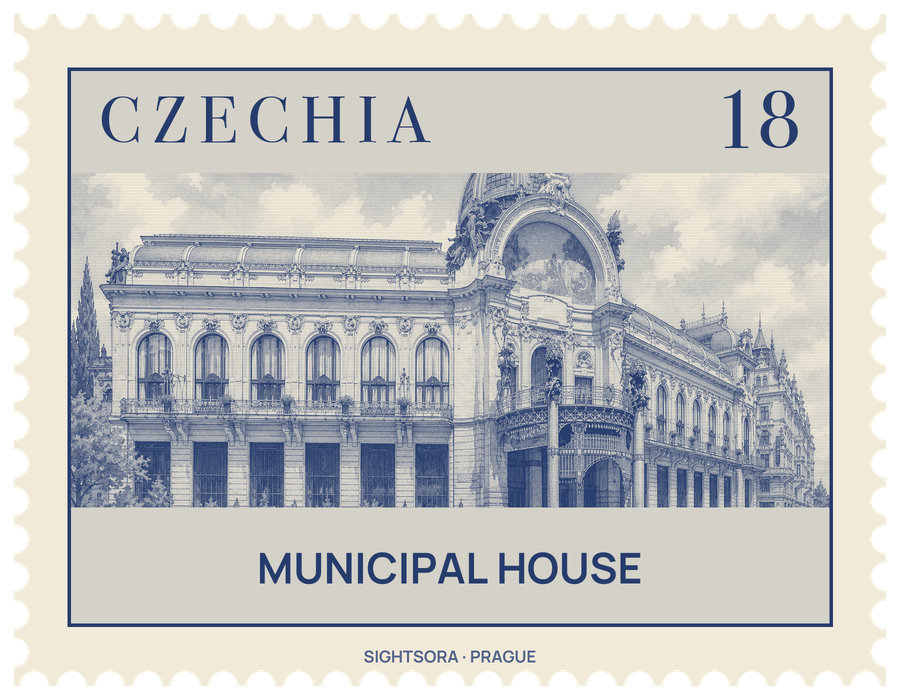
Construction began in 1905 to designs by Osvald Polívka and Antonín Balšánek, and the building opened in 1912. The site had royal history long before that: around 1380 King Wenceslas IV built the Royal Court palace here, and the kings of Bohemia lived in it from 1383 until 1485, after which it stood abandoned until its demolition early in the 20th century. In 1918 the Municipal House was where Czechoslovak independence was declared.
The facade is a show of allegory and stucco. Above the entrance, Karel Špillar's mosaic Homage to Prague spreads across the front, and the sculpture groups by Ladislav Šaloun on either side are allegories of a people's degradation and of its resurrection. The centre of the building is Smetana Hall, a concert hall and ballroom under a glass dome, and the interiors hold work by the artists Alfons Mucha, Max Švabinský and Jan Preisler.
The house still serves as a concert venue, ballroom and civic building, and orchestras and recitals fill its programme. Off the lobby are a café on one side and a French restaurant on the other, with a wine bar and an American bar below ground. Many of the representative rooms can only be seen on guided tours.
Getting there
The Municipal House is at náměstí Republiky 5 in Praha 1 – Staré Město. From the Můstek station on metro line A it is about a four-minute walk. Trams 6, 8, 15 and 26 stop at Nám. Republiky; trams 3, 6, 9, 14 and 24 stop at Jindřišská; and trams 3, 6, 14, 15, 24 and 26 stop at Masarykovo nádr.