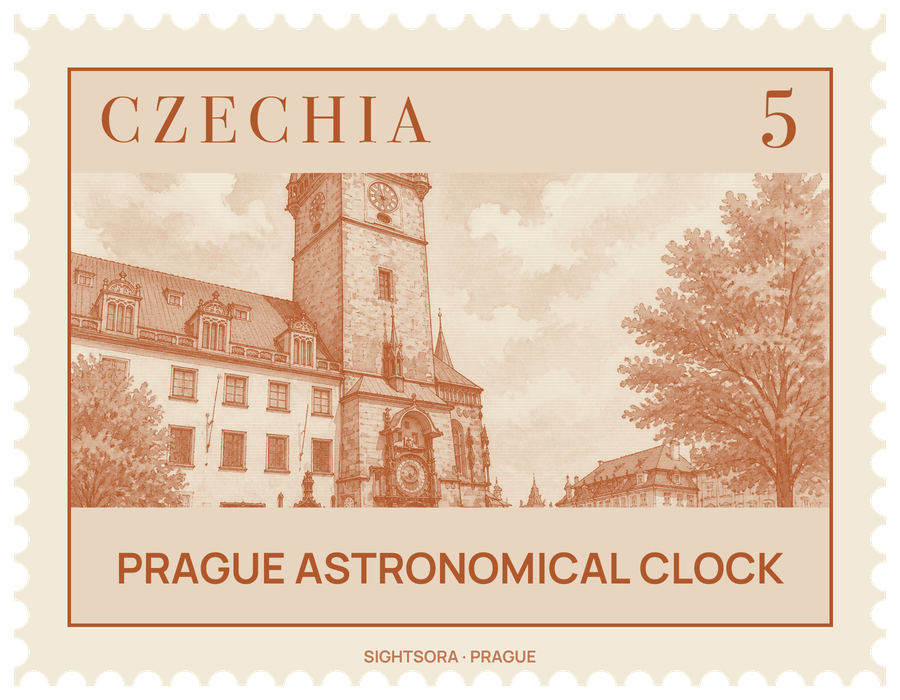
Its oldest parts, the clockwork and the astronomical dial, were made in 1410 by the clockmaker Mikuláš of Kadaň together with Jan Šindel, who taught mathematics and astronomy at Charles University; the clock is first recorded on 9 October 1410. The calendar dial and the Gothic sculpture on the façade followed, probably around 1490.
For a long time the clock was credited to a master called Jan Růže, or Hanuš, who rebuilt the Old Town Hall in 1470–1473. A legend retold by Alois Jirásek says the councillors had Hanuš blinded so that he could never build another, and that he took revenge by disabling it. The mix-up came from misread records and was corrected by Zdeněk Horský. The clock has stopped and been repaired many times: the Apostle figures came with the big overhaul of 1787–1791, the golden rooster in 1865–1866. On 8 May 1945, during the Prague uprising, the Nazis fired on the square from armoured vehicles and set the hall ablaze and burned the wooden figures and the Josef Mánes calendar face; Vojtěch Sucharda restored the Apostles and the clock ran again in 1948. In 2018 a renovation replaced the electric drive used since 1948 with an original mechanism from the 1860s.
The astronomical dial works as a mechanical astrolabe. A blue centre stands for the Earth and the sky above the horizon, with red and black zones for dawn, dusk and night. A golden Sun travels round a zodiac ring and its golden hand tells the time three ways: local time on Roman numerals, unequal hours on curved golden lines, and Old Czech Time on an outer ring of Schwabacher numerals counted from sunset. The Moon moves faster on its own arm, and its half-silvered, half-black sphere turns slowly to show the lunar phase, driven only by a weight; that mechanism probably dates from the mid-17th century.
At the strike of each hour, a skeleton representing Death rings its bell and the figures beside the dial shake their heads: vanity with a mirror, a miser with a bag of gold, and a Turkish figure for earthly pleasure. Above, two windows slide open and the Twelve Apostles pass by in pairs, though the set differs from the gospels: Paul and Barnabas appear in place of James the Great and Matthew. Statues of a philosopher, the archangel Michael, an astronomer and a chronicler stand beside the calendar below.
The calendar plate shows allegories of the months, small images of the zodiac signs and, round the edge, a church calendar with the names of 365 saints. The plate on the clock is a copy installed in 1880; the original by Josef Mánes is kept in the Prague City Museum. An old legend links the fate of the city to the clock: if it is left to decay, Prague will come to harm.