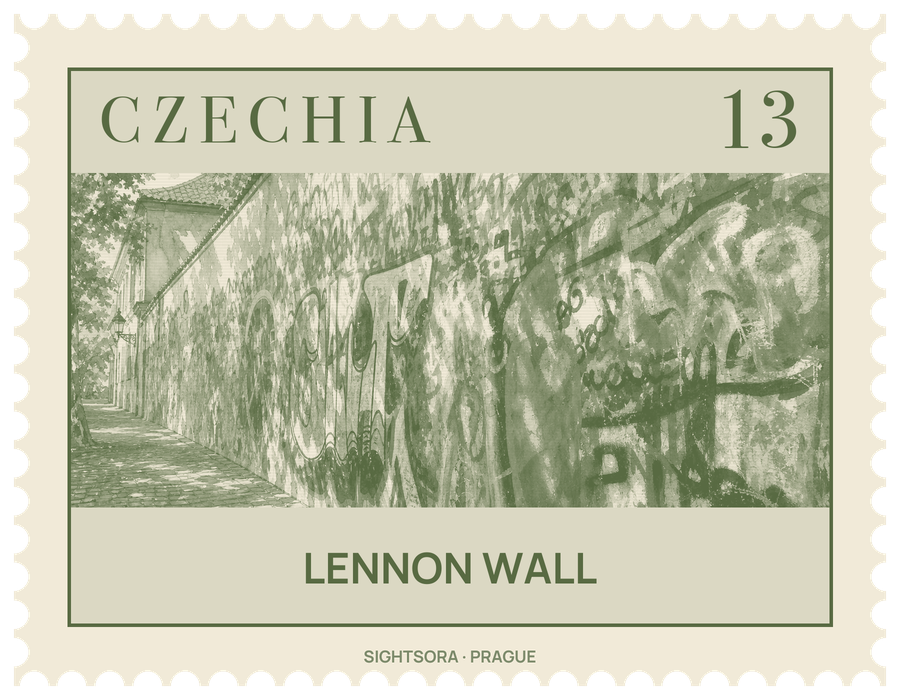
Its theme is John Lennon, but the painting also takes up local and global causes, and the wall has inspired others around the world, including the Lennon walls of Hong Kong. It belongs to the Sovereign Military Order of Malta.
Love poems and brief anti-government messages appeared on the secluded wall as early as the 1960s. After Lennon was murdered in 1980, an unknown artist painted his image and some lyrics on a stone slab where a public fountain had once stood, and a small memorial of candles, flowers and newspaper clippings grew around it. Because Western culture was suppressed at the time, the authorities read it as protest: in April 1981 the secret police painted it over in green, and the very next day it was covered again with poems and political lines such as "Palach would cry". Guards and cameras could not keep the wall clean, and in 1988 grievances written on it ended in hundreds of students clashing with security police on nearby Charles Bridge; the authorities called the young people's movement Lennonism.
After the fall of communism the wall kept changing, and the first portrait of Lennon vanished under new paint. For the 25th anniversary of the Velvet Revolution in 2014, art students whitewashed it apart from a single line, "wall is over", and on Earth Day 2019 Extinction Rebellion painted it white around the words Klimatická Nouze, "climate emergency". Later in 2019 the Order of Malta and Prague 1 had the wall renewed: under the designer Pavel Šťastný more than 30 Czech and foreign artists painted new designs, a reflective metal piece with a black outline of Lennon was set in the centre, and the wall was declared a memorial site, its first official recognition. A small museum, the Lennon Wall Story, opened in 2021 on Prokopská Street 8 with photos and Beatles memorabilia, and in 2024 a portrait of the Romani singer Věra Bílá by the artist Maxim Muchow joined the wall.