Long before the present building, a medieval parish church dedicated to the same saint occupied the site; the Prague bishop Tobiáš consecrated it in 1283. The parish ranks the church among the finest Baroque works anywhere north of the Alps.
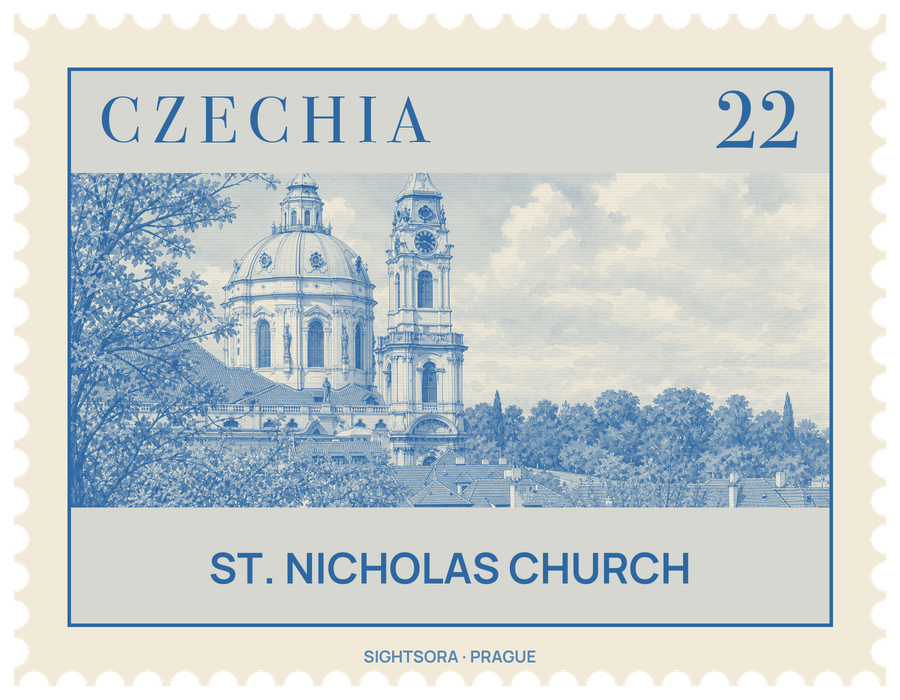
The Jesuits, who were given the old Gothic church sometime after 1620, resolved in the later 17th century to replace it, and the cornerstone of the new church was laid in 1673. Three generations of one family of architects shaped what visitors see today: Kryštof Dientzenhofer, his son Kilián Ignác Dientzenhofer and his son-in-law Anselmo Lurago. The father is credited with the massive nave, whose vault undulates over a system of intersecting ellipsoids; the son designed the chancel and its copper cupola, built in 1737–1752; and Lurago finished the 79-metre belfry in Rococo forms in 1751–1756. After the Jesuit order was abolished, the church took over in 1775 as the chief parish church for Malá Strana.
Inside, the eye is drawn upward to the dome, which rises 70 metres and carries a fresco by František Xaver Palko; the ceiling of the nave shows the Apotheosis of St. Nicholas. Jan Lukas Kracker painted many of the frescoes, and the sculptures are the work of František Ignác Platzer. The geometry of interconnected cylinders and pillars between the wide arches of the arcade gives the interior a sense of movement rather than a static hall.
The Baroque organ has more than 4,000 pipes, the longest of them six metres, and Mozart played it in 1787; shortly after his visit his Mass in C was first performed here. The church still hosts organ and church music concerts. Its tower has a stranger history: during the Communist era State Security used it as an observation post, because from the top it was possible to watch the American and Yugoslav embassies and the approach to the West German embassy. The belfry is connected directly to the dome and is known for its panoramic view over the city.