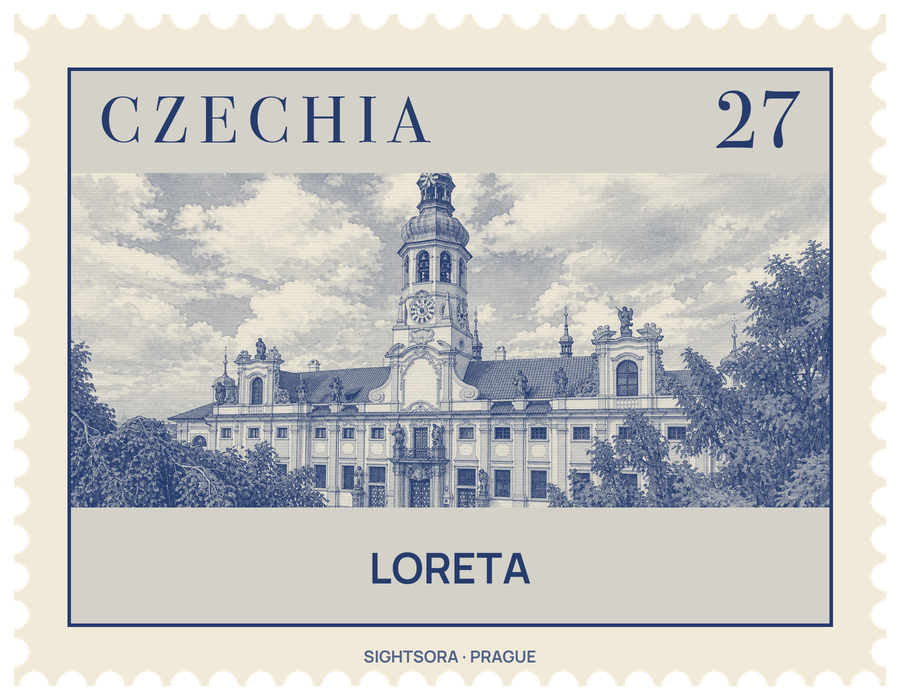
Such lorettos were a Baroque form of devotion: architectural replicas of the Santa Casa, the holy house venerated at an Italian shrine. Work on the Prague complex started in 1626, and its Holy Hut received its blessing on 25 March 1631.
Kateřina Benigna, a noblewoman from the Lobkowicz family, financed the project, which was designed by the Italian architect Giovanni Orsi. About fifty years later cloisters were built around the Santa Casa, and after 1740 Kilián Ignác Dientzenhofer gave them an upper storey. The Baroque façade, designed by Christoph Dientzenhofer together with Kilián Ignác, was added early in the 18th century.
Loreta is best known for its chime, which has rung out since 15 August 1695. The watchmaker Peter Neumann assembled it in 1694 from thirty bells of different sizes. Inside, the complex keeps a large collection of liturgical objects, above all monstrances, and the first floor of the cloister is used from time to time for exhibitions.