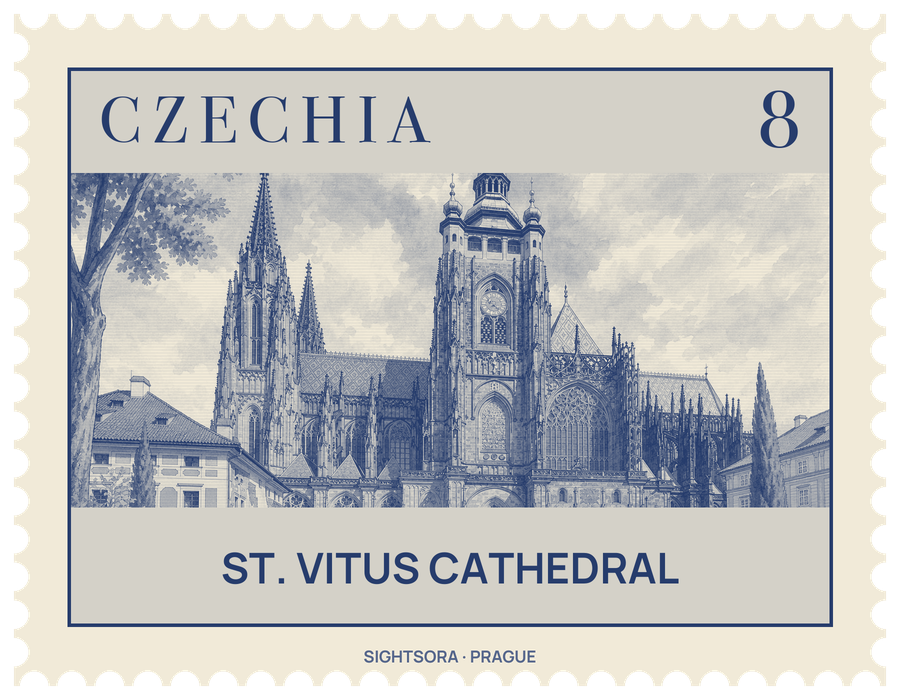
It is the seat of the Archbishop of Prague and has been at once the coronation church of Bohemia's rulers, their burial place and the shrine of St. Wenceslaus, the country's patron. Until 1997 it was dedicated to St. Vitus alone, which is why most people still call it St. Vitus Cathedral. The building measures 124 by 60 metres, and the vaults rise 33.2 metres above the floor.
Two earlier churches stood on the spot: a Romanesque rotunda founded by Duke Wenceslaus I in 930, which held a relic of St. Vitus, and a larger basilica begun by Prince Spytihněv II in 1060. The present building was started on 21 November 1344, when Prague became an archbishopric, with Charles IV as its great patron. The first master builder, Matthias of Arras, came from the Papal Palace in Avignon and brought a French Gothic plan; after his death in 1352 the 23-year-old Peter Parler took over and gave the choir its net vaults, whose doubled ribs form a zigzag pattern along the ceiling. Hussite iconoclasm and a fire in 1541 left the cathedral half-built for centuries, and only in 1929, for the jubilee of St. Wenceslaus, was it completed, nearly 600 years after the first stone. Its western half, including the twin-towered façade, is a Neo-Gothic addition by Josef Mocker and Kamil Hilbert that follows Parler's forms.
Inside, the Chapel of St. Wenceslaus holds the saint's relics. Parler built it between 1356 and 1364; more than 1300 semi-precious stones encrust its lower walls, framing Passion paintings from 1372–1373, while scenes from Wenceslaus's life by the Master of the Litoměřice Altarpiece cover the upper walls. A Gothic statue of the saint by Jindřich Parler stands above the altar. The chapel is viewed from its doorways, and a small door with seven locks in its corner leads to the Crown Chamber, where the Bohemian crown jewels are kept. Parler's busts on the triforium show the royal family, saints, bishops and both master builders.
The cathedral chapter points to hundreds of works of art inside by Czech and foreign artists, among them Alfons Mucha, František Kysela and Max Švabinský. Mucha decorated windows in the north part of the nave in the 1920s, and Kysela designed the rose window of 1925 to 1927 with scenes of the Creation. On the south side, the mosaic of the Last Judgment over the so-called Golden Gate marks the portal through which kings entered for their coronations; the last of them, Ferdinand V, was crowned king of Bohemia here in 1836. The south tower carries a Baroque spire by Nikolaus Pacassi, and the Hilbert Treasury keeps the skull of St. Adalbert.
Music has its own history here. A Baroque organ case of 1765 by Anton Gartner survives purely as decoration, and below it stands the neoclassical instrument built by Josef Melzel in 1929–31. On 15 June 2026 a new organ by Gerhard Grenzing was completed, with 122 stops on four manuals and pedals, 5,755 pipes and 180 crystal ornaments designed by Peter Olah.