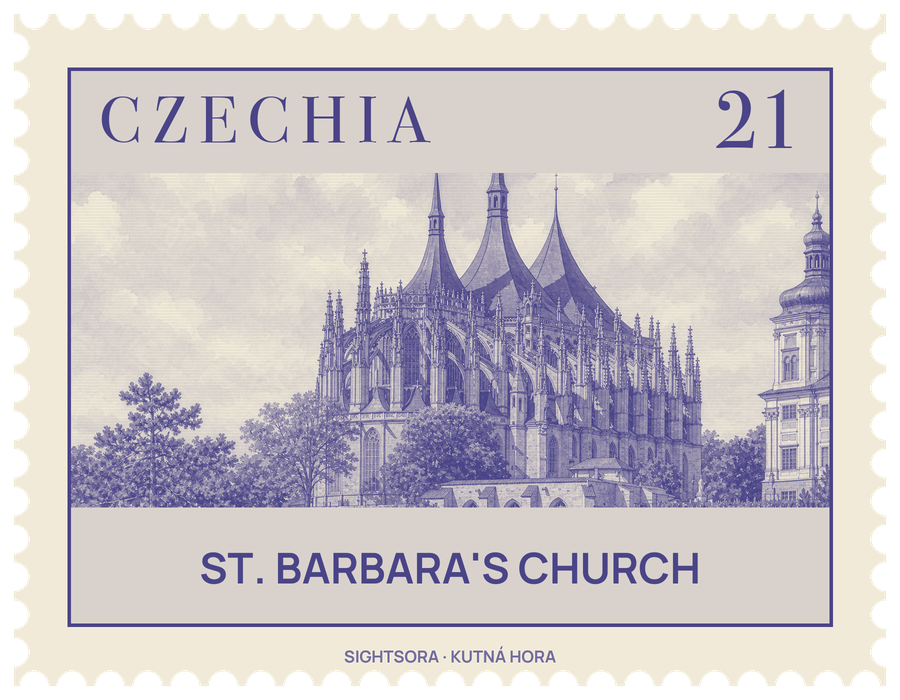
Its patron, Barbara, is among other things the protector of miners, a natural choice for a town that grew rich on silver mines. The church stands beyond the Old Town, behind the Jesuit College, on ground that once lay outside the town, and UNESCO lists it as World Heritage.
The building took more than five centuries to finish. Work started in 1388, probably under Johann Parler, son of Peter Parler, then stopped for over 60 years during the Hussite Wars; when building resumed in 1481, it passed to Matěj Rejsek, Mikuláš Parler and Benedikt Rejt. The plan was for a far larger church, perhaps twice the present size, but as the silver mines yielded less, money ran short, and in 1588 the work ended with the three-peaked roof complete and a provisional wall closing the building. The Jesuits who later took it over gradually gave it Baroque features, though Gothic parts remain, and the architects J. Mocker and L. Labler carried out the final repairs and completion at the end of the 19th century; it was finished in 1905.
Around the choir, double-arched flying buttresses support the walls, and the east end began with eight radial chapels, each with a trapezoidal interior. Inside, visitors can look at the stained-glass windows, the altars, pulpits and choir stalls. Parts of the medieval frescoes survive, some showing religious subjects and others the everyday, secular life of the medieval mining town.