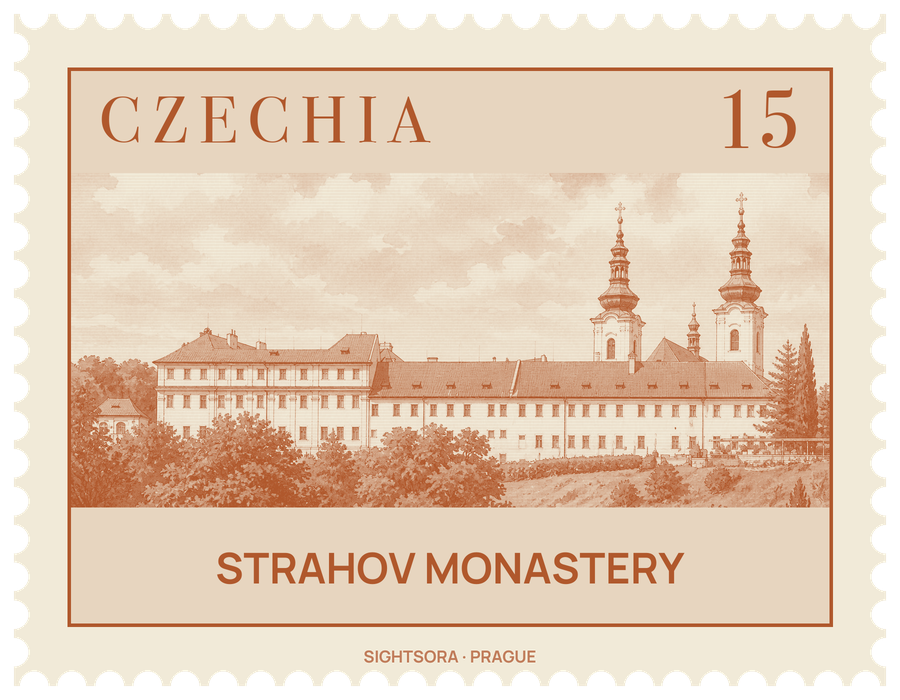
It was founded in 1143 on the initiative of Jindřich Zdík, bishop of Olomouc, who had returned from a pilgrimage to the Holy Land; the first Premonstratensians came here from Steinfeld in the Rhine valley. For visitors the monastery means a historic library with two great halls, a picture gallery, the abbey basilica and gardens with views across Prague.
The abbey has been rebuilt many times. The first monks lived in wooden buildings around a Romanesque basilica, later replaced in stone; fire damaged the monastery in 1258, and in 1420 citizens of Prague attacked it and burned its books and furnishings. Revival came with abbot Jan Lohelius, who arrived in 1586 and rebuilt the church, the living quarters and the gardens. His successor, Kašpar Questenberg, carried on through the Thirty Years' War, and under him, in 1627, the remains of Norbert of Xanten, founder of the order, were brought from Magdeburg. They lie in the abbey basilica, which the monastery calls its spiritual centre. Swedish troops looted the church and library late in that war, and Prague's bombardment by French and Bavarian troops in 1742 brought another round of rebuilding.
The library is the reason most people come. Abbot Jeroným Hirnheim built the Theological Hall, completed in 1679, and abbot Václav Mayer added the Classical-style Philosophical Hall after 1779, the last large building project at Strahov. The ceilings carry frescoes by Siard Nosecky and Anton Maulbertsch, and the collection runs to more than 200,000 volumes; over 3,000 of them are manuscripts, and 1,500 first prints are kept apart in a special depository. Among the treasures on show is the bible of Jan of Šelmberk from 1440.
In 1950 the communist regime took the monastery over, interned the brothers and turned the complex into the Memorial of National Literature; archaeological research in those years uncovered and carefully reconstructed the forgotten Romanesque form of the buildings. After 1989 the abbey went back to the Premonstratensians, and by 1994 the church had been restored, the library renewed and the Strahov picture gallery newly built. The gallery shows a collection of paintings and other fine art spanning several centuries.