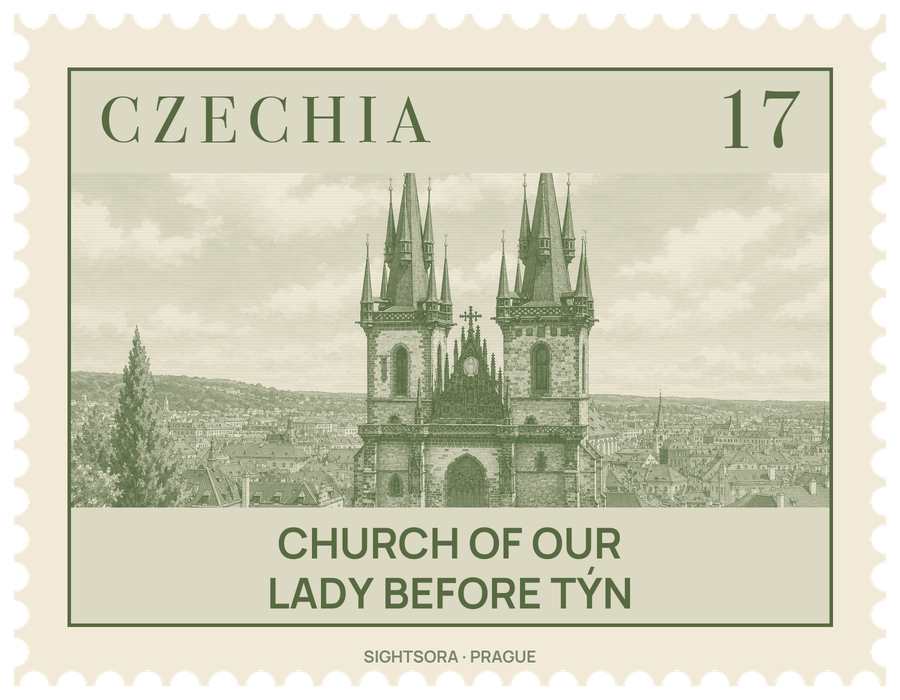
Since the 14th century it has served as the principal church of the Old Town. Its story starts with the merchants from abroad who came to the nearby Týn Courtyard: a Romanesque church built for them stood here in the 11th century, followed in 1256 by an early Gothic one, and work on the present building started in the 14th century, shaped first by the ideas of Matthias of Arras and then by Peter Parler.
The church carries the marks of the religious conflicts of the Czech lands. For two centuries it was in Hussite hands, and John of Rokycan, later royal administrator of the vacant archdiocese, became its vicar in 1427. Under George of Poděbrady the gable and northern tower were completed, and his statue was set on the gable beneath a huge golden chalice, the Hussite emblem; the southern tower followed only in 1511, under Matěj Rejsek. After the defeat at White Mountain in 1620, the statue and chalice were taken down in 1626, and the chalice was melted to make the giant halo of the Virgin Mary that replaced them. A lightning strike in 1679 started a fire that ruined the old vault, and a lower Baroque vault was built in its place. In 2017 the Czech bishops decided to return a golden chalice to the church, and the final version, of gilded copper sheet, was designed by Petr Malinský.
The main entrance is on the west front, reached through a narrow passage between the houses that stand before the church. The building is a tall three-aisled basilica with a short polygonal presbytery and deep polygonal chapels at the ends of the side aisles, which still have their Gothic ribbed vaults while the nave is covered by the Baroque one. Four Gothic portals lead in. The north portal, from the Parler workshop, has a tympanum relief of the Passion crowded with figures, a major work of Gothic sculpture from before the Hussite period. Between the towers rises a Gothic gable with a Baroque relief of the Madonna, edged by rows of finials.
Several medieval furnishings survived inside: a baptismal font of 1414, a stone pulpit in the nave, a stone baldachin of 1493 by Matěj Rejsek, and two works by the Týn Calvary Master, the Madonna of Týn and a Calvary group at the end of the north aisle. An altar by the Master IP, worked in high relief in about 1530, shows the baptism of Christ, with side scenes that echo prints by Albrecht Dürer. Most of the furnishing, though, is Baroque. The main altar of 1649 holds Karel Škréta's Assumption of the Virgin Mary, and other altars carry sculpture by Jan Jiří Bendl and Ignác František Weiss and paintings by Petr Brandl and Jan Jiří Heinsch. The organ was built by Jan J. Mundt in 1670–1673. Among the carved tombstones and epitaphs is the grave of the astronomer Tycho Brahe at the first pillar on the south side of the nave.