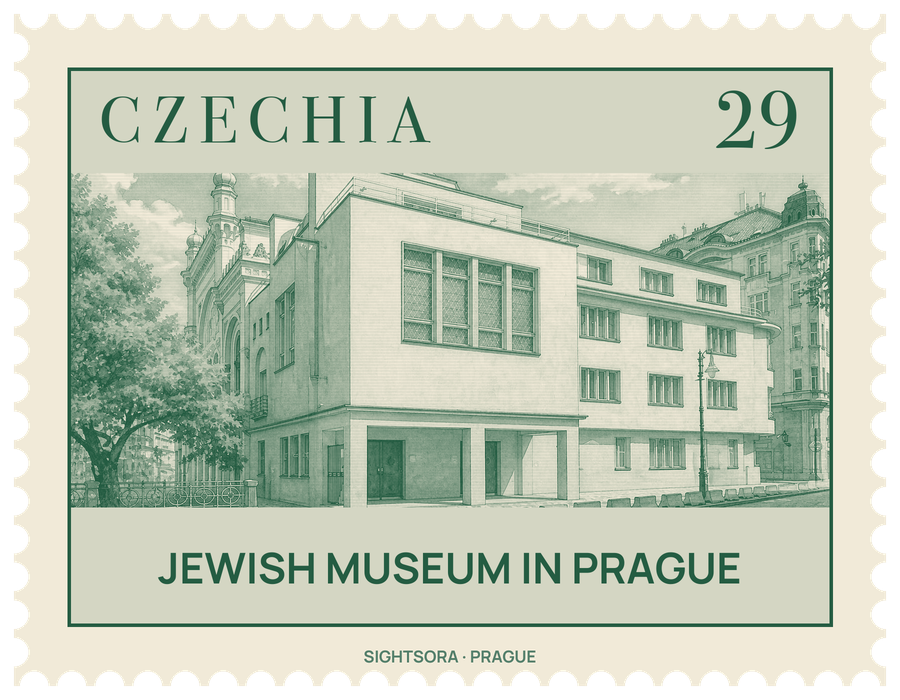
Together they tell the history, traditions and customs of the Jews of Bohemia and Moravia over many centuries, and they also keep the memory of those murdered in the Shoah. The museum looks after more than 44,000 objects, a library of 130,000 books and a large archive on the Jewish communities of the Czech lands.
Among the sites in its care are the Old-New Synagogue, which is still used for worship, and the Old Jewish Cemetery, a historic burial ground. The Pinkas Synagogue is home to the memorial honouring Shoah victims from Bohemia and Moravia. The Maiselova synagoga carries the name of the banker and benefactor who built it, a head of the Jewish quarter and one of the wealthiest people of the city, and the Klausová synagoga, the largest that survives from the former ghetto, was built in an early baroque style.
The permanent exhibitions follow Jewish life in Bohemia and Moravia from the 10th to the 18th century and through the 19th and 20th centuries. One exhibition presents drawings made by children in the Terezín ghetto between 1942 and 1944.
The museum itself has a history bound up with that of the community. The historian Salomon Hugo Lieben and the city councillor August Stein founded it in 1906, gathering objects from the synagogues pulled down when the Prague ghetto was cleared at the start of the 20th century. Under the Nazi occupation the original association was dissolved in 1939, and in 1942 the Central Jewish Museum was set up on the initiative of Karel Stein; it became the place where liturgical objects, books and documents from destroyed communities were collected, and its staff, led by the art historian Josef Polák, kept it working through the war.
The Second World War took the lives of around 77,297 Czech Jews, and almost no one was left to reclaim what had been gathered. The museum reopened on 13 May 1945 under Hana Volavková, and the poet and scholar H. G. Adler brought it documents he had saved from the Theresienstadt ghetto. After the Communist takeover it became state property in 1950 as the State Jewish Museum, and its work was heavily restricted for decades. In 1994 the buildings and the Old Jewish Cemetery returned to the Jewish Community of Prague, and from 1 October 1994 the museum was once more independent of the state.